
A clean and well-organised kitchen is the foundation of safe meal preparation. Most people concerned with kitchen safety usually emphasise washing their hands and storing food properly. However, among the most overlooked tools is the chopping board, which plays a major role in both preventing and spreading harmful bacteria.
Whether you’re cutting raw chicken, fresh vegetables, or bread, the chopping board you use and how you use it plays a big role in keeping your kitchen hygienic. With increasing recognition of the importance of cross-contamination prevention, it has become necessary to know how to handle chopping boards properly to avoid infections and ensure safer food preparation on a daily basis.
Understanding Cross-Contamination
Cross-contamination is the transmission of disease-causing bacteria to another food source. Generally, this happens through surfaces, utensils, or hands that have not been washed but are shared.
Raw meat is the primary source of bacteria such as Salmonella and Campylobacter; however, vegetables can also carry organisms from the soil if they are not washed properly. Even bread is not safe anymore, as it can get bacteria if the slicer that was used for cutting the raw ingredients is not cleaned. As soon as these products come into contact with contaminated surfaces, they further spread the risk.
Symptoms of diseases may vary after consuming contaminated food due to cross-contamination, ranging from mild stomach upsets to severe infections caused by E. coli. This is why cross-contamination prevention in the kitchen should be considered an essential task.
Why Choose Plastic Chopping Boards?
The majority of contemporary kitchens have plastic chopping boards as a staple, and for good reason. They also offer several advantages over wooden or bamboo versions, particularly for raw meat and other potentially hazardous foods.
Key Benefits
Non-porous surface
Wooden boards are known to absorb liquids, whereas plastic does not. The lack of soaking prevents bacteria from penetrating the plastic surface, thereby minimising long-term contamination.
Dishwasher friendly
Plastic does not react to heat; therefore, it can be washed at high temperatures, ensuring quick and thorough cleaning.
Cost-effective and practical
No major investment is required for their replacement; they are easy to carry, and you can get colour-coded sets, which provide an extra safety feature.
Common Misconceptions
Some people believe plastic is not very strong or is unsafe when scratched. While deep grooves do require attention, proper cutting board maintenance ensures longevity. With regular checks and timely replacement, plastic chopping boards remain one of the safest choices for everyday cooking.
Using Coloured Chopping Boards for Safety
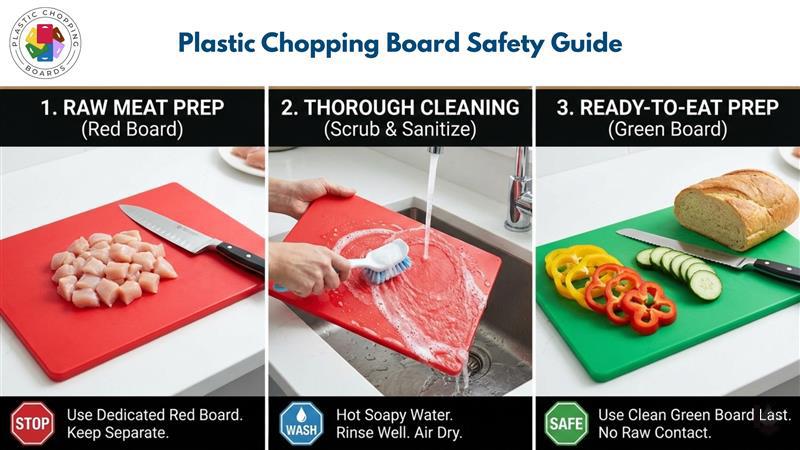
Coloured chopping boards are one of the simplest yet most effective methods for preventing cross-contamination. The colour-coding system lets you assign each board to a specific food type, reducing the risk of misusing it.
Standard Colour-Coding System
- Red – Raw meat
- Blue – Fish & seafood
- Green – Fruits & vegetables
- Brown – Cooked meats
- White – Bread & dairy
If a person follows the system, they can easily keep track of each board’s purpose, especially when preparing multiple ingredients simultaneously. In homes with busy schedules, mixing raw and cooked food equipment is a frequent cause of accidents. Colour-coding is a visual tool that helps people practice safety without effort.
Tips for Implementation
- Ensure boards are stored in multiple locations and are easily accessible and visible.
- Inform all household members of what each colour represents.
- Have the most frequently used colours replaced more often.
- Don’t forget to clean each board after you have finished using it to maintain good hygiene.
Colour-coding is a means of cross-contamination prevention that is not only simpler but also more consistent.
Chopping Board Cleaning & Maintenance
Proper, thorough cleaning is a key factor in food safety. By following well-known chopping board cleaning tips, you will not only care for your boards but also ensure no harmful bacteria remain after meals.
Daily Cleaning Routine
- Hot, soapy water: Clean the board thoroughly on all sides and rinse.
- Cleaning the dishwasher: Fill the top rack with plastic boards for a thorough cleaning.
Deep Cleaning & Disinfection
More intensive cleaning is always recommended alongside daily cleaning to ensure the boards are fully safe.
- Bleach solution: 1 teaspoon of bleach in 1 litre of water. Pre-soak the board, then rinse it in water.
- Vinegar solution: A disinfecting agent that is also eco-friendly and quite efficient in the removal of odours.
- Baking soda scrub: Removes old stains and helps neutralise lingering odours.
Maintenance Tips
- Check grooves: Bacteria can enter the deep cuts in your board. When grooves become deep enough, it is safer to either lightly sand them or replace your board altogether.
- Periodic replacement: One method of cutting board maintenance is knowing when the board is no longer usable. Plastic boards cost very little; therefore, it is advisable to discard them when they are severely degraded.
Best Practices in Cross-Contamination Prevention.
It is best to have the appropriate tools and habits in the kitchen to maintain hygiene.
Use separate boards
Never place raw meat on the same board as vegetables or bread. Just remember to keep the food categories separate.
Wash hands regularly
Are you taking the chicken from the cutting board to the fruit? Wash your utensils and hands first. By doing so, the bacteria will not be spread accidentally.
Do not stack ingredients
If you put raw chicken on the board that was just used to cut carrots, you can be sure bacteria will spread immediately.
Store boards in a good way
Make sure the boards are thoroughly dried before storing them. Check whether they are stored vertically or if air is flowing between them. Food-spoiling bacteria thrive in wet, enclosed areas.
When you adhere to these rules every day, the risk of cross-contamination is minimal.
Conclusion
When preparing a safe meal, the first step is to understand how contamination occurs and how to use the right tools to prevent it. Using plastic chopping boards, washing them, and colour-coding them will help maintain a cleaner kitchen environment through simple practices.
As an added measure to reinforce the new habits, conduct regular inspections, handle everything carefully, and maintain consistent hygiene, making your kitchen a home of freshness and safety. When you need a durable, food-safe cutting board, check out the extensive selection at Plastic Chopping Boards.
FAQs
1. How frequently should I change my plastic chopping boards?
You might require a new chopping board after every 6 to 12 months in case you cook frequently. The clues that you need to replace your boards are deep grooves, unwashed stains, or lingering odours.
2. Can I use one board for everything if I clean it well?
Yes, in theory, but it remains a risky practice. Using various boards is a safer, easier way to prevent accidental contamination.
3. Are plastic chopping boards safer than wooden chopping boards?
Yes, when it comes to raw meats. Plastic is non-porous and thus can be easily disinfected, particularly when a dishwasher is used.
4. How can I easily get the strong odours out of my board, such as garlic or fish?
Baking soda mixed with water is the best solution. Apply the paste, leave it for a while, and then rinse thoroughly.