
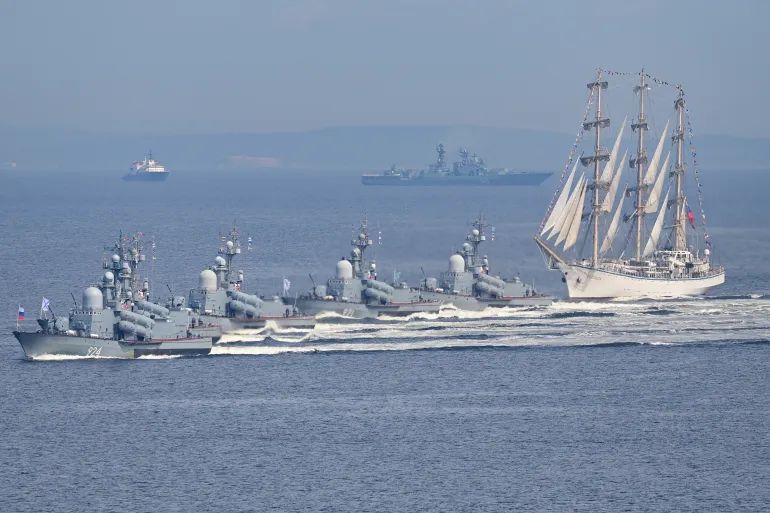
In recent years, the world has watched a remarkable transformation in global maritime dynamics as Russia and China deepen their naval cooperation in the Pacific Ocean. This growing partnership, often referred to as the Russia–China joint naval exercises in the Pacific, is reshaping aspects of international security and regional diplomacy.
The joint operations typically involve fleets from both countries carrying out coordinated drills, communications training, and complex maneuvers. These exercises take place across strategic zones of the Pacific, highlighting shared interests in securing free navigation routes, enhancing tactical coordination, and demonstrating their ability to operate together on the high seas.
This collaboration attracts global attention because it represents much more than standard military cooperation. It signals deeper diplomatic ties between Moscow and Beijing at a time when both nations face heightened geopolitical pressure from Western countries. The Russia–China joint naval activity in the Pacific serves as a reminder that the balance of power on the oceans — particularly in the Indo-Pacific region — continues to evolve in new and complex ways.
The Strategic Background Behind the Russia–China Naval Alliance
The roots of the Russia–China naval relationship trace back several decades, though the intensity and sophistication of their cooperation have increased notably since the early 2000s. Both nations share long-term defense goals centered on protecting their respective maritime interests, expanding regional influence, and countering perceived external threats.
Historically, Russia and China had moments of rivalry and tension, particularly during the Cold War. Yet, modern developments — such as changing global economic structures and collective priorities for regional stability — have brought them closer. For Russia, the Pacific offers a vital outlet for defending its Far East territories and maintaining naval relevance beyond European waters. For China, strengthening maritime partnerships in the Pacific supports its broader vision of a powerful blue-water navy capable of operating globally.
Milestones such as the “Joint Sea” series of drills have symbolized this strengthening maritime alliance. These exercises illustrate growing trust and coordination, marking a shift from cautious exchanges to comprehensive cooperation aimed at long-term strategic outcomes.
What the Joint Naval Exercises in the Pacific Aim to Achieve?
At their core, the Russia–China joint naval exercises in the Pacific are designed to improve mutual understanding and enhance operational capabilities. The forces train together on navigation, communication, and defense operations, allowing each side to learn from the other while developing shared procedures.
One of the key goals is interoperability — the ability for ships, aircraft, and crews from both nations to work as a single, efficient unit. The drills often simulate real-world crisis scenarios, from anti-submarine warfare to maritime defense operations, ensuring readiness and resilience.
Beyond the military skill-building aspect, the exercises also carry a significant strategic message. By conducting joint operations in such a strategically vital ocean, Russia and China demonstrate that they are not isolated players but coordinated powers capable of acting in unison. This is particularly relevant as both nations seek to present themselves as counterweights to Western naval activities in the Asia-Pacific region.
These training operations also serve diplomatic and symbolic purposes. The visible presence of Russian and Chinese fleets cooperating in the Pacific underscores a shared commitment to shaping the regional maritime order — one less dominated by traditional Western influence.
The Pacific Region’s Role in Russia–China Defense Strategy
The Pacific is a natural theater for Russia–China joint naval collaboration due to its vast economic, strategic, and symbolic importance. This region connects major trade routes and serves as a gateway between Asia, North America, and Oceania. Control and influence over parts of this ocean translate directly into power and security advantages.
For China, the Pacific represents both opportunity and vulnerability. Its economic lifelines — involving vital shipping channels — pass through waters that are heavily monitored by other major navies. By strengthening its presence with Russia, China aims to protect these routes and safeguard its growing overseas interests.
For Russia, the Pacific offers strategic depth and naval diversification. The Russian Pacific Fleet, based in Vladivostok, provides access to open waters and the ability to project power beyond its northern territories. Collaboration with China allows Russia to remain a strong maritime actor in the Indo-Pacific despite Western sanctions and diplomatic isolation.
Together, their partnership in this region serves as a platform to reinforce sovereignty, ensure maritime security, and subtly challenge the dominance of Western-led alliances such as the U.S. and its Pacific partners.
Global Reactions and Regional Implications
The Russia–China joint naval operations in the Pacific inevitably draw reactions from neighboring countries and global powers. The United States and its allies, such as Japan, South Korea, and Australia, closely monitor these exercises, interpreting them as a sign of tightening military alignment between two major rivals of the Western bloc.
Regional governments express a mix of caution and concern. Some view the cooperation as a response to increased Western presence in the Indo-Pacific, while others see it as a signal of greater polarization in regional security affairs.
From a strategic standpoint, these exercises influence how countries plan their naval developments and alliances. Japan, for instance, has been expanding its maritime security cooperation with Western allies, while Southeast Asian nations carefully balance relations to avoid being drawn into broader contestations.
In essence, the Russia–China naval partnership introduces new complexities to the Asia-Pacific security equation. As both nations increase their visibility, regional powers must adapt to this changing environment — one defined by shifting currents of cooperation and competition across the Pacific waters.
Military, Political, and Economic Dimensions of the Partnership
The Russia–China naval collaboration goes beyond maritime maneuvering. Militarily, it reflects a growing level of trust and long-term planning. The exercises test technologies, command systems, and coordination between two distinct naval traditions.
Politically, the partnership conveys unity in the face of external pressure. Both nations frame their cooperation as a defensive measure, aimed at ensuring regional stability rather than confrontation. It also strengthens their diplomatic narratives — presenting an image of responsible powers ready to safeguard peace and order through collaboration rather than aggression.
Economically, shared ambitions in defense technology and energy cooperation augment the naval ties. Joint projects in shipbuilding, marine engineering, and resource exploration indirectly support this military relationship. By intertwining economic and security objectives, Russia and China reinforce a multidimensional partnership that extends far beyond the ocean surface.
Ultimately, the naval alliance forms part of an integrated approach blending military readiness, political cooperation, and economic interdependence — a triad that strengthens both nations’ positions in an increasingly multipolar world.
Challenges and Future Direction of Russia–China Naval Collaboration
Despite notable progress, the Russia–China joint naval relationship in the Pacific is not without challenges. Operationally, the two navies rely on different systems, communication methods, and logistical standards. Perfecting interoperability across such differences remains an ongoing task.
There are also subtle differences in long-term strategic goals. China’s focus is global expansion and maritime dominance, while Russia’s priorities often revolve around regional power projection and internal security. These differing ambitions could occasionally create friction in defining common maritime objectives.
Furthermore, external pressures — such as sanctions, economic slowdowns, or regional disputes — may affect the tempo or scale of future exercises. However, both nations continue to indicate that their cooperation in the Pacific will expand, not contract. Upcoming joint drills are expected to incorporate new technologies, such as unmanned systems and digital coordination platforms, reflecting a modernization of their naval approaches.
The partnership appears poised to deepen, emphasizing resilience, self-reliance, and mutual support, even as the broader global order remains uncertain.
Conclusion – Reading the Currents of Change in the Pacific
The Russia–China joint naval operations in the Pacific capture a defining moment in twenty-first-century maritime relations. They showcase how two major powers have transformed historical rivalry into strategic cooperation, using the Pacific Ocean as a stage to project unity, capability, and shared intent.
This collaboration highlights shifting global tides — away from unilateral dominance and toward more complex systems of partnerships. For both nations, the Pacific remains more than a training ground; it is a canvas on which they paint a message of influence, independence, and ambition.
As the waves of change continue to shape the world’s oceans, the growing synergy between Russia and China will remain a key factor in the evolving balance of power across the Pacific and beyond. Their joint efforts suggest not only a changing maritime landscape but also a deeper reconfiguration of global diplomacy, where cooperation on the waves reflects an era of shared strategic purpose.