
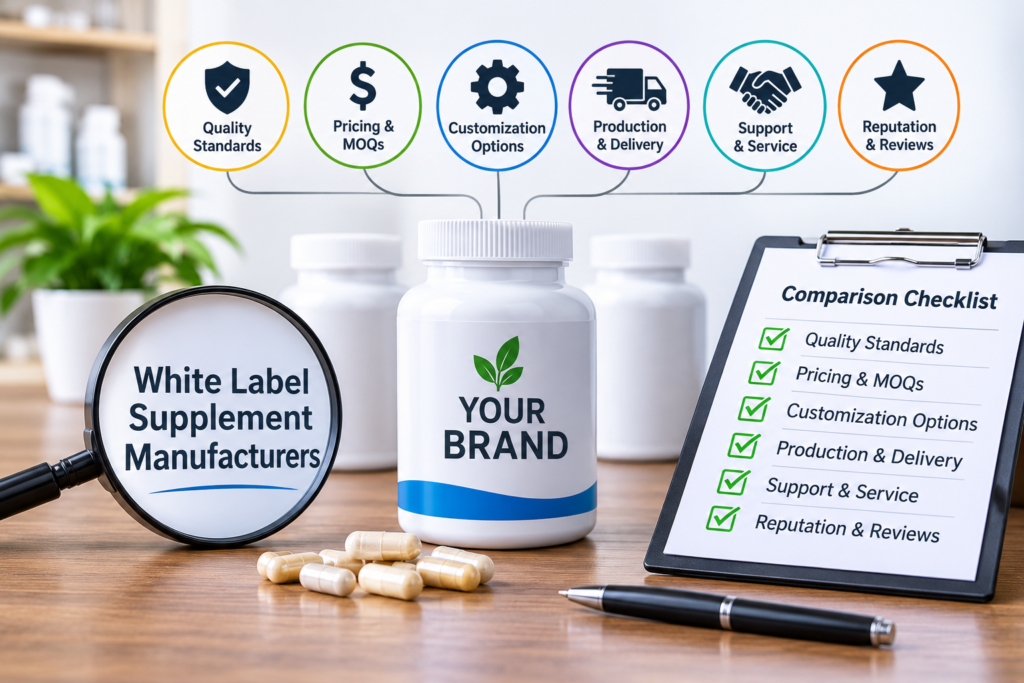
Lists of the best contract suppliers are usually ranked by catalog breadth, price per unit and how quickly a sample arrived. Those are real signals, but they measure convenience rather than whether the product can be sold in every planned market and reordered without a renegotiation.
Criterion one is formula ownership. Some suppliers license their own formulas, some assign them, and some keep a formula as intellectual property while granting a single-brand use. The difference shows up at the worst moment: when a brand grows, wants exclusivity, or wants to move production and discovers the recipe is not portable.
Criterion two is dose honesty. A white-label catalog built to hit a low unit price typically uses token amounts spread across a long ingredient list. Compare the per-serving amounts against published intake ranges rather than the ingredient count. best white label supplement manufacturer conversations become simple when the brand asks for one meaningful dose and pays for it.
Criterion three is minimum order quantity in practice. A stated MOQ of ten thousand bottles sounds manageable until the brand learns it is ten thousand per SKU, applies to each flavor, and repeats at every label revision. Ask whether the number is per formula, per packaging component or per production slot.
Criterion four is documentation depth. A finished product certificate of analysis is the minimum. Useful additions are ingredient-level certificates, a statement of additives and allergens, a heavy metals report with numeric limits, and a method name for each assay. Registration in several markets needs a process description as well.
Criterion five is packaging flexibility. A brand that can choose bottle color, closure type, label material and pack count can adapt to retail requirements. A brand that must accept the house standard gets a faster launch and fewer options later, and changing component choice after a launch means new artwork and new barcode assignments.
Criterion six is reorder terms. Price validity, lead time for repeat orders, whether the formula can be revised without restarting qualification, and how raw material substitution is handled all determine whether a product is sellable in year two. Requote risk is a margin issue, not an administrative one.
Sampling should be evaluated rather than received. Test the shipped sample against the specification: label accuracy, unit count, seal integrity, taste and texture after a week of warm storage, and the certificate of analysis against the stated range.
Marketplace readiness is a practical filter for first-time brands. Retail channels increasingly require a documented quality file, an allergen statement and a barcode registration. A supplier who has produced for those channels supplies them without being asked, and one who has not will treat each document as a special request.
Price comparison is only valid across identical scope. A quote that includes labeling and a quote that includes only filling are not the same number, and neither is comparable to a turnkey price that includes packaging, testing and freight to port. Build a scope grid before comparing figures.
The useful conclusion from any ranking is a checklist. Ownership, dose, MOQ arithmetic, documents, packaging choice and re-order terms. Suppliers that survive those six questions are worth a pilot order, and the ones that do not are usually expensive in a way the unit price hid.
Scoring the six criteria on a single page before requesting samples turns a catalog review into a comparison. Write the criterion down the side, the supplier across the top, and record a document name or an actual number in each cell. A blank cell is the finding, and it is usually the reason a project stalls after the first order rather than after the second.
Leave a Reply