
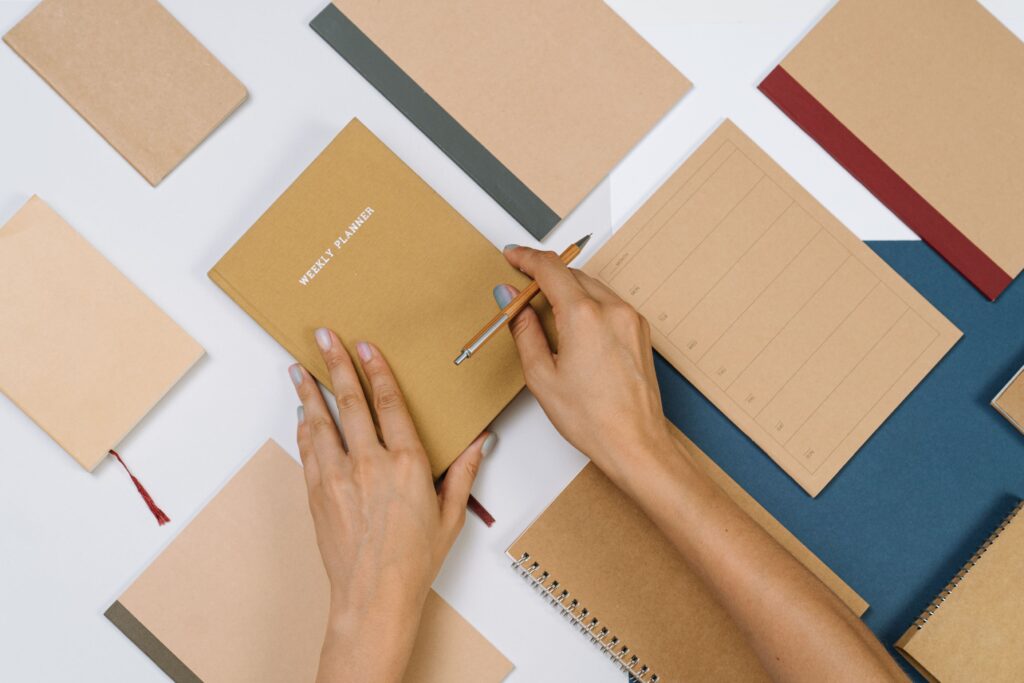
A traveler’s notebook is a refillable leather cover that holds several slim notebooks at once, fastened with elastic bands instead of a fixed binding. Rather than buying a new journal every time one fills up, you keep the same cover for years and swap the paper inside: one insert for a diary, another for lists, another for sketches or tickets. Originally made in Japan by the company now known as Traveler’s Company, under the Midori brand, the system has grown into a worldwide habit for travellers, journal keepers and stationery lovers.
The appeal is easy to understand once you hold one. A normal notebook forces every kind of note into the same pages, in the same order, on the same paper. A traveler’s notebook lets you separate things out without carrying four different books: itinerary, diary and sketches can each live in their own insert, inside a single slim cover.
What Is A Traveler’s Notebook?
At its simplest, a traveler’s notebook is a leather cover with elastic bands threaded through the spine. Thin paper notebooks, called refills or inserts, slide under the elastics, so you can add, remove and rearrange them at will. A starter kit usually comes with the leather cover, a set of elastics and one blank paper refill, ready to use straight away.
The leather is the part that ages with you. Covers made by Traveler’s Company are handmade in Chiang Mai, Thailand, from vegetable-tanned leather that softens and darkens with use. Scratches and a gradually deepening colour are considered part of the character of the notebook, not damage to be avoided.
The paper matters just as much as the cover. Traveler’s Company refills use Midori MD paper, a Japanese paper designed to resist feathering and ghosting, which means ink from pens, including many fountain pens, sits on the surface rather than bleeding through to the other side.
Regular Or Passport: Which Size Should You Choose?
The first decision, and the most important one, is size. Traveler’s Company makes two main sizes, and refills are made to match one size or the other, so it pays to choose carefully before buying inserts.
The Regular Size
The Regular size is the classic traveler’s notebook. It is tall and slim, with generous room for writing. It suits a desk, a day bag or a tote, and it is the better choice if you plan to journal at length, plan in detail or sketch. If you only buy one size, most guides recommend starting here, because it is the more versatile of the two.
The Passport Size
The Passport size is the compact option, small enough for a jacket pocket or a small bag, and, as the name suggests, designed to fit a standard passport. It is ideal for travel, quick notes and pocket lists. The trade-off is page space: it suits brief entries, lists and small sketches rather than long journal entries.
There is no wrong answer, and plenty of enthusiasts end up owning both. If you are still unsure, ask yourself where the notebook will actually live. If the answer is a bag, choose the Regular. If the answer is a pocket, choose the Passport. For more ideas on planning a trip worth writing about, see our travel guides.
How The Refill System Works
The refill system is the heart of the traveler’s notebook, and it is simpler than it first looks. Each insert is a slim stapled notebook with a kraft paper cover. To add one, open the insert to its middle pages and slide it under one of the elastic bands in the spine of the cover.
One insert can be held by the elastic already fitted in the cover. To hold two or three inserts comfortably, you add extra elastics, known as connecting bands, which loop around the spine and create additional slots. Most users find that three paper inserts are a comfortable limit for everyday carrying; a fourth can fit, but the cover starts to bulge and the paper edges can stick out past the leather.
Refills come in a wide range of paper types, each identified by a number. Useful ones to know when you start include the 001 lined refill for everyday writing, the 026 dot grid refill for journaling and flexible layouts, and the 014 kraft paper refill for collage, tickets and mementos. There are also blank, grid and lightweight paper options, plus diary and weekly planner refills, folders, card files and zip cases. The key rule is simple: Regular refills fit the Regular cover, and Passport refills fit the Passport cover, so always check the size before ordering. A detailed guide to sizes and refills is useful if you want to compare options before buying.
Setting Up Your Traveler’s Notebook Step By Step
Setting up a traveler’s notebook for the first time takes a few minutes and no tools. Start with the cover and the refill that comes in the box, and add to it only when you know what you want the notebook to do.
- Open the leather cover flat and look at the elastics threaded through the spine. One elastic runs around the outside to keep the notebook closed.
- Take the blank refill, open it to its middle pages, and slide it under the inside elastic so the elastic sits in the centre fold. Close the cover and check that the insert sits evenly.
- If you want a second insert, loop a connecting band around the spine, then slide the second insert under the new band in the same way.
- Add a pen holder, a bookmark or a charm only if you will use them. A notebook weighed down with accessories on day one is harder to carry and less inviting to open.
- Label the spine or cover of each insert with its purpose, such as diary, lists or sketches, so you can find the right one at a glance.
Do not feel obliged to fill every slot immediately. Many long-term users start with a single insert and add a second only when the first role becomes clear.
Choosing Refills And Accessories That Suit You
The range of refills can feel overwhelming at first, so it helps to choose by purpose rather than by number.
For A Daily Journal
Lined or dot grid paper suits most journal writers. Lined paper keeps handwriting tidy and is ideal for longer entries, while dot grid paper gives structure without visible lines, which suits a mix of writing, lists and small sketches. Blank paper is the freest option and works well for people who like to draw or mind-map.
For Planning And Lists
Weekly and monthly diary refills turn a traveler’s notebook into a planner, useful for counting down to a trip or tracking bookings. For lists, a simple lined or grid insert works well, and many users keep one insert purely for lists: packing lists, things to do, places to eat. Kraft paper inserts are a favourite for travel, because tickets, maps and receipts can be stuck or tucked into them alongside notes.
Using A Traveler’s Notebook On A Trip
A traveler’s notebook earns its name on the road. Before a trip, one insert can hold the itinerary: flight times, hotel addresses, reservation numbers and a rough plan for each day. Keeping this separate from your journal means you can check practical details without flicking past personal writing.
During the trip, a daily journal insert becomes the record that photographs alone cannot make. A photo shows what a place looked like; a few lines written the same evening capture what it smelled like, what you ate, who you spoke to, and what surprised you. Even ten minutes of writing a day builds a record that is far richer to read back a year later than a camera roll alone.
A third insert can act as a scrapbook for the trip: tickets, postcards, labels and notes tucked into kraft paper, with a zip case keeping loose items safe until you have time to stick them in properly.
For inspiration on the writing side, our collection of travel quotes captures why so many travellers bother to write things down at all.
Everyday Uses Beyond Travel
Despite the name, a traveler’s notebook does not need a trip to be useful. Many owners use one as an everyday carry notebook, a work planner, a commonplace book, or a bullet journal. One insert can hold a daily task list, another can hold meeting notes, and a third can hold ideas worth keeping. Because inserts can be swapped, a notebook that starts as a work tool can become a holiday journal in a single swap, without buying anything new.
The system also suits people who like to separate projects. A writer might keep one insert per project, a student one per subject, and a gardener one per season. When a project ends, its insert can be archived on a shelf while the cover moves on to the next one.
Looking After The Leather Cover
Leather care for a traveler’s notebook is refreshingly simple. Daily use is the main maintenance: the natural oils from your hands keep the leather supple, and the cover softens and develops character the more you carry it. A small amount of a beeswax-based leather conditioner applied every few months will help prevent cracking in dry conditions.
A few habits will keep the cover looking its best. Avoid soaking it, and if it gets wet, let it dry naturally rather than with direct heat. Keep it out of prolonged direct sunlight when you are not using it, and do not overstuff it: a cover forced shut around too many inserts will stretch the elastics and strain the spine. Elastics themselves are replaceable, and replacing a stretched band takes a minute.
Conclusion
A traveler’s notebook is less a product than a habit with a cover around it. Choose the size that matches where you will carry it, start with one or two refills that match real purposes in your life, and let the system grow as your habits become clear. Keep an itinerary insert for trips, a journal insert for memories, and a place for the tickets and scraps that make a journey feel real. Look after the leather, replace the elastics when they tire, and do not worry about keeping the cover perfect. Years from now, when the inserts on your shelf tell the story of trips taken and ordinary days noticed, you will be glad you started with something built to last.
Frequently Asked Questions
What Is The Difference Between A Traveler’s Notebook And A Normal Journal?
A normal journal has a fixed binding and a set number of pages. A traveler’s notebook is a reusable leather cover with elastic bands, so you can swap, add and rearrange slim paper inserts, mixing different paper types in one cover.
Should I Choose The Regular Or Passport Size?
Choose the Regular size if you want generous writing space and carry a bag, and the Passport size if you want a pocket notebook for quick notes and travel. Regular refills only fit the Regular cover, and Passport refills only fit the Passport cover.
How Many Inserts Can A Traveler’s Notebook Hold?
Most users find three paper inserts comfortable for everyday carrying, using connecting bands for the extra inserts. A fourth can fit, but the cover may bulge and the paper edges can stick out past the leather.
Can I Use Fountain Pens In A Traveler’s Notebook?
Yes, in most cases. The original refills use Midori MD paper, which is designed to resist feathering and ghosting, so it handles fountain pens and wet gel inks well. Very wet media on speciality papers such as kraft may behave differently.
Is A Traveler’s Notebook Only For Travel?
No. Many owners use one daily as a planner, bullet journal, commonplace book or project notebook. Inserts can be swapped so the same cover serves work, study, creative projects and travel at different times.
Leave a Reply