
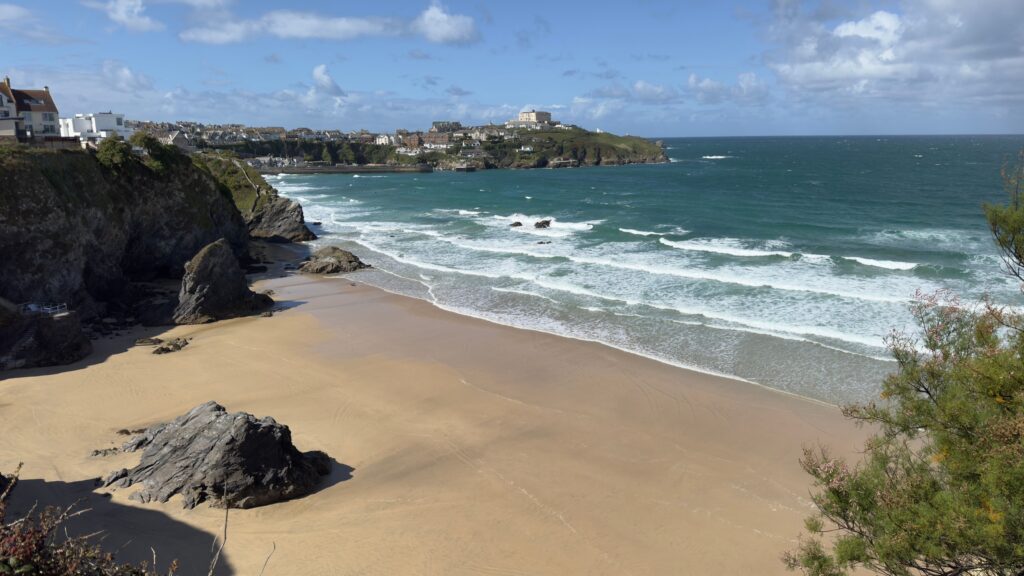
Cornwall is the county at the far south-western tip of England, and it feels different from the rest of the country. The light is brighter, the coastline is wilder, and the villages seem to belong to another century. In a single trip you can walk a clifftop path above the Atlantic, cross a tidal causeway to a castle island, and end the day with fresh seafood in a harbour town.
This guide covers what to see in Cornwall, from the famous names to the quieter corners, following a simple route: St Ives and the north coast, Tintagel, the far west around Land’s End, the gardens inland, and the fishing villages and beaches of the south coast.
Key Takeaways
- Start with St Ives for art and beaches, Tintagel Castle for legend and views, and St Michael’s Mount for a tidal island castle.
- The far west, around Land’s End, the Minack Theatre and Porthcurno, holds Cornwall’s most dramatic coastal scenery.
- The Eden Project near St Austell is the best all-weather option, with rainforest and Mediterranean biomes inside giant domes.
- Allow time for the fishing villages: Padstow, Fowey, Port Isaac and Mousehole each have a character of their own.
St Ives And The North Coast
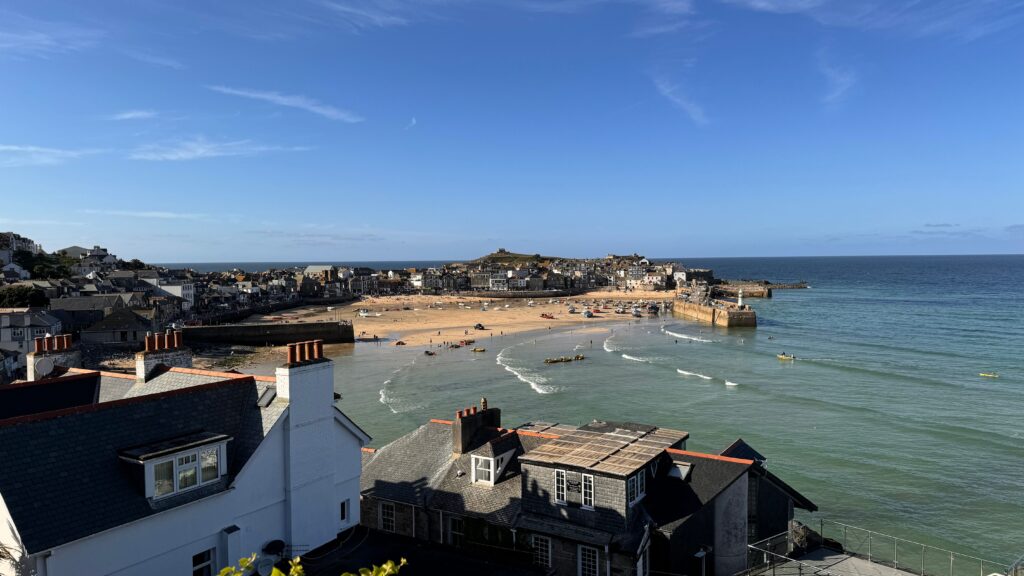
St Ives is the most popular town in Cornwall, and it is easy to see why. The town sits on a peninsula with golden beaches, a working harbour and a quality of light that has drawn artists for generations. Tate St Ives, overlooking Porthmeor Beach, shows modern British art with strong Cornish connections, and the Barbara Hepworth Museum and Sculpture Garden preserves the home and garden of one of Britain’s best-known sculptors. A walk around the harbour and a swim at Porthminster Beach are a fine way to spend a day.
The north coast around St Ives rewards slow exploration. Newquay, to the north-east, is the county’s surfing centre, and Fistral Beach is its best-known surf beach. Further along the coast, Padstow is a harbour town famous for its food, with seafood restaurants and the Camel Trail, a flat estuary walk and cycle route inland to Bodmin. Port Isaac, a small fishing village with narrow streets and a sheltered harbour, is worth a stop for its atmosphere alone.
Tintagel Castle And Arthurian Legend
On the rugged north coast, Tintagel Castle is Cornwall’s most dramatic historic site. The ruins of a 13th-century castle stand partly on the mainland and partly on a rocky island, joined today by a modern footbridge across the gorge. The 12th-century writer Geoffrey of Monmouth identified Tintagel as the birthplace of King Arthur, and that legend has drawn visitors ever since. The setting is extraordinary: steep cliffs, a small sandy beach below, and Merlin’s Cave at the foot of the rocks, which can be explored when the tide is out.
The site is managed by English Heritage, and entry is by ticket, with free entry for members. A one-way route leads visitors across the bridge, around the island ruins and back down a long flight of steps, so allow a couple of hours and wear sturdy shoes. Opening times and prices vary by season, so check the English Heritage website before you travel and book ahead where you can.
St Michael’s Mount And The Tidal Causeway
St Michael’s Mount is one of Cornwall’s most memorable sights: a tidal island topped with a medieval castle and gardens, rising out of Mount’s Bay near Marazion. At low tide a cobbled causeway appears and you can walk across on foot; when the tide comes in, boats carry visitors instead. The castle was once a 12th-century abbey built by Benedictine monks, and it is now managed jointly by the National Trust and the St Aubyn family, who still live there.
Inside, the castle rooms and terraced gardens are open to visitors, with views across the bay to Penzance and the Lizard Peninsula. The climb is steep in places, and the causeway crossing depends on the tide, so check tide times before you set out. Marazion itself has a long sandy beach with views back to the Mount. For more ideas across England, see our guide to things to do in England.
The Minack Theatre And Porthcurno
Near the village of Porthcurno in the far west, the Minack Theatre is an open-air theatre carved into the cliffs above the sea. It was created by Rowena Cade in the 1930s, and performances still take place there in summer, with the ocean as a backdrop. Even without a show, the theatre and its gardens are worth visiting for the views, and the beach below at Porthcurno is one of the most beautiful in Cornwall, with white sand and clear turquoise water framed by granite cliffs.
The far west, the Penwith Peninsula, is the wildest part of the county. The coast road between St Ives and Sennen is one of the most scenic drives in the UK, passing moorland and small coves. Sennen Cove, near Land’s End, is a wide sandy beach popular with surfers, and Mousehole, near Penzance, is a quiet harbour village with narrow streets. This is the Cornwall of granite, heather and open Atlantic light.
Land’s End And The Far West
Land’s End is the most westerly point of mainland England, a headland of cliffs and moorland where the land runs out into the Atlantic. It is an Area of Outstanding Natural Beauty, with clifftop trails and views towards the Isles of Scilly on a clear day. The headland is free to visit, with a visitor centre, shops and cafes nearby, and the coastal path runs in both directions.
The far west is best explored slowly. The Lizard Peninsula, to the south, is the most southerly point of mainland Britain, with coves such as Kynance Cove, known for its turquoise water, and the village of Cadgwith, a working fishing cove with thatched cottages. The Lost Gardens of Heligan, near Mevagissey, offer a different kind of escape: a large garden estate with woodland walks, walled gardens and a jungle valley.
The Eden Project And Gardens Inland
Inland, the Eden Project near St Austell is Cornwall’s biggest paid attraction and its best all-weather option. A disused quarry has been transformed into enormous domes, or biomes, housing rainforest and Mediterranean planting from around the world. Inside the Rainforest Biome you can walk through humid jungle planting and climb a canopy walkway, while the Mediterranean Biome is drier and full of olives, vines and herbs.
Cornwall’s mild, sheltered climate suits gardens, and there are several others worth visiting. The Lost Gardens of Heligan, near St Austell, are the best known after Eden, while Trebah and Glendurgan on the Helford River offer wooded valleys leading down to the water. National Trust houses such as Lanhydrock, near Bodmin, and Cotehele, on the River Tamar, combine historic houses with gardens and woodland walks.
Fishing Villages And Harbour Towns
Cornwall’s fishing villages are among its greatest pleasures, and each has a character of their own. Fowey, on the south coast, is a harbour town set on a steep-sided estuary, with colourful houses and a literary connection: Daphne du Maurier set her novel Rebecca on this coast, and the house that inspired Manderley, Menabilly, stands nearby. Falmouth, further west, is a larger harbour town with a maritime museum and a castle at Pendennis. Mevagissey is a smaller, working harbour with narrow streets, and a good base for the south coast.
On the north coast, Port Isaac and Boscastle offer a quieter kind of harbour, and Boscastle is a good starting point for walks along the coast path to Tintagel. For a full list of the county’s highlights, Visit Cornwall has guides to towns, villages and attractions, and our round-up of the sites to see in the UK puts Cornwall in a wider British context. Wherever you stop, look for the local catch: crab, mackerel and sardines are Cornish staples, and a Cornish pasty from a good bakery is a meal in itself.
Beaches Worth Seeking Out
Cornwall’s beaches range from wide surf strands to tiny coves reached only on foot. Fistral Beach in Newquay is the county’s surfing capital, with surf schools and a long stretch of golden sand. Porthcurno, near the Minack Theatre, is one of the prettiest beaches in the country, with white sand and clear water. Kynance Cove on the Lizard is famous for its turquoise sea and rock stacks, though it is best visited at low tide, when the sand is exposed.
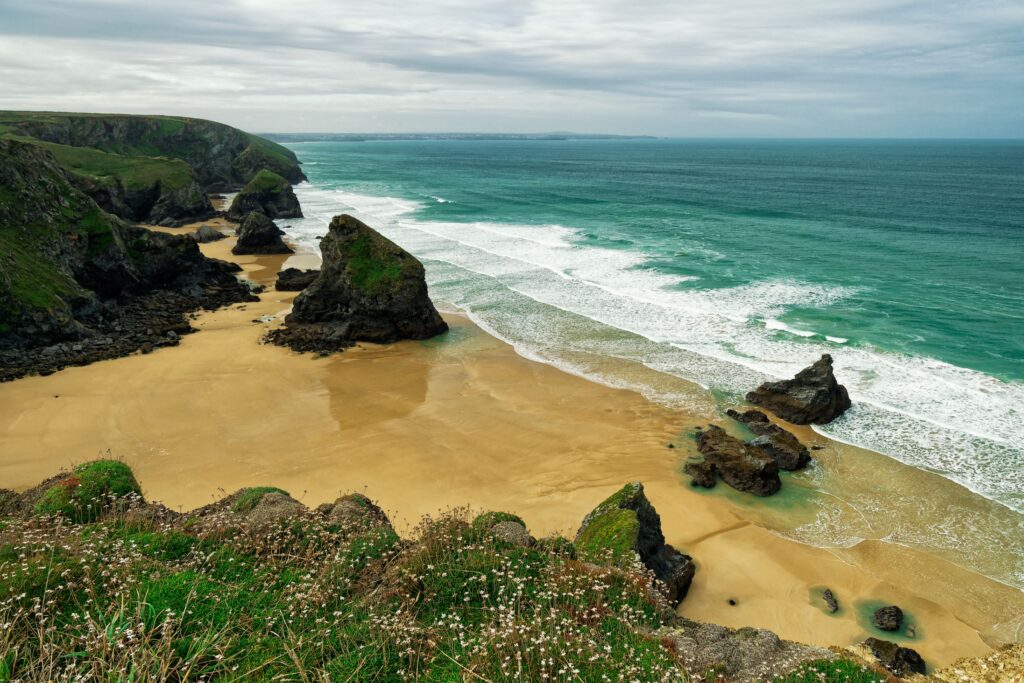
Bedruthan Steps, between Newquay and Padstow, is a dramatic stretch of coast where large rock stacks rise from the beach below towering cliffs. The beach is reached by a steep staircase and is not safe for swimming, so it is best enjoyed from the clifftop path, especially at sunset. For families, the wide sands of St Ives Bay, Watergate Bay and Perranporth offer space and easy access. Before swimming anywhere, check local safety advice and watch for rip currents.
Practical Tips For Visiting Cornwall
Cornwall rewards planning, because distances can be deceptive. The county is long and narrow, and country lanes are slow, so base yourself in one area and explore from there. St Ives or Penzance suit the west, Newquay or Padstow suit the north coast, and Falmouth or Fowey suit the south. Trains run from London to Penzance via Plymouth and Truro, but a car gives you far more freedom once you arrive.
- Visit outside school holidays where you can: the coast is quieter and stays are often cheaper.
- Check tide times before visiting St Michael’s Mount or Kynance Cove, and book popular attractions ahead in summer, especially the Eden Project and the Minack Theatre.
- Pack layers and a waterproof jacket, even in summer.
- Respect the coast path: keep to marked routes, keep dogs on leads near cliffs and livestock, and take litter home.
For day-trip ideas beyond Cornwall, see our guide to days out in the UK. With a little planning, Cornwall gives you a holiday that feels both far away and easy to reach.
Frequently Asked Questions
What Is The Best Place To Visit In Cornwall For The First Time?
St Ives is the best first stop for most visitors, with beaches, galleries, a harbour and easy walks. From there you can reach the Eden Project, Tintagel Castle and St Michael’s Mount as day trips.
How Many Days Do You Need In Cornwall?
Three to four days is enough to see the main highlights, while a full week lets you explore at a slower pace. If you only have a weekend, base yourself in one area, such as St Ives or Falmouth, rather than trying to cover the whole county.
Can You Walk To St Michael’s Mount At Low Tide?
Yes, at low tide a cobbled causeway appears and you can walk across from Marazion beach on foot. When the tide comes in, boats carry visitors instead. Always check tide times before you set out.
Is Tintagel Castle Worth Visiting?
Yes, for the setting alone. The ruins stand on a dramatic headland and island, joined by a modern footbridge, with views along the north coast and down to Merlin’s Cave. Allow a couple of hours and wear sturdy shoes.
What Is The Best Beach In Cornwall?
It depends on what you want. Fistral Beach in Newquay is best for surfing, Porthcurno is best for scenery, Kynance Cove is best for turquoise water, and the wide sands of St Ives Bay are best for families.
Do You Need A Car In Cornwall?
A car is very helpful, since buses are infrequent in rural areas and many beaches and villages are hard to reach without one. Trains run to Penzance, Truro and St Ives, but a car gives you the freedom to explore the coast path and the quieter corners.
Sources
- Visit Cornwall — official tourist board guides to towns, villages and attractions in Cornwall.
- English Heritage — Visit Tintagel Castle — opening times, tickets and the history of the castle, bridge and Merlin’s Cave.
- English Heritage — Facts and FAQs about Tintagel Castle — location, opening seasons and visitor information.
- Cornwall Online — Cornwall Tourist Attractions — Eden Project, St Michael’s Mount, Minack Theatre, Land’s End and gardens.
- England Tourism — Best Places to Visit in Cornwall — St Ives, Tintagel, Eden Project, Minack Theatre and harbour villages.
- Pexels — Scenic View of Beach in Newquay, Cornwall, photo by Esslam Abouelela
- Pexels — A View of the Beach and Houses from a Balcony (St Ives), photo by Stephan Leuzinger
- Pexels — Rocky Seashore Landscape at Carnewas, Bedruthan, photo by Carsten Ruthemann
Leave a Reply