
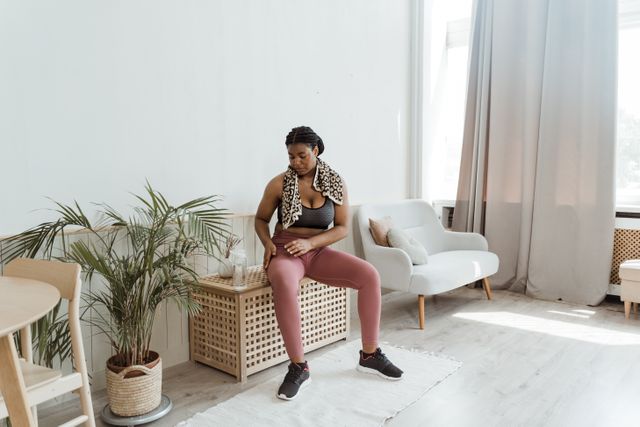
You do not need a gym membership, expensive equipment or an hour of free time to get fit. A living room floor, a sturdy chair and twenty minutes are enough to cover most of what the NHS recommends for adults, and the evidence for home exercise is clear: short, regular sessions done at home work just as well as gym sessions for general health, as long as you actually do them.
Most home workout plans fail not because of the exercises, but because the plan is too ambitious, too complicated, or built around equipment you do not own. This guide keeps it simple: how much exercise you need, how to set up a space, the moves that matter most, and a 20-minute routine you can start today.
How Much Exercise Do You Actually Need?
The NHS guidelines for adults aged 19 to 64 are straightforward. Aim for at least 150 minutes of moderate-intensity activity a week, or 75 minutes of vigorous activity, or a mix of the two. Moderate activity is anything that raises your heart rate and makes you breathe faster while still letting you talk, such as brisk walking or a steady bodyweight circuit. Vigorous activity makes talking difficult, such as running or fast cycling.
Also do strengthening activities for all major muscle groups, legs, hips, back, abdomen, chest, shoulders and arms, on at least two days a week. The guidelines also suggest spreading activity evenly over four to five days rather than cramming it all into the weekend. That is good news for home exercise: three 20-minute sessions and a couple of brisk walks can cover most of the target.
The guidelines are a floor, not a ceiling, and any activity is better than none. The British Heart Foundation makes the same point in its home workout advice: even one or two sessions a week can reduce the risk of heart disease and stroke. If you have not exercised for some time, or you have a heart condition or another health problem, speak to your GP before starting a new routine.
Setting Up Your Space And Kit
You need less space than you think. A clear patch of floor about the size of a yoga mat, roughly two metres by one metre, is enough for almost every bodyweight exercise. Move the coffee table, roll up the rug if it slips, and make sure there is nothing sharp at head height. A room with a door you can close helps if you share the house and want twenty uninterrupted minutes.
As for kit, you can start with nothing at all. A yoga mat or a folded towel makes floor work kinder on knees and elbows, and a sturdy chair is useful for step-ups, dips and supported squats. A set of resistance bands costs a few pounds, takes up no space, and can make the same moves harder without any weights. Water bottles work as light dumbbells in a pinch, and a filled rucksack works as a weight for squats and lunges.
Wear comfortable clothes you can move in and trainers with grip, or bare feet on a mat. Keep water nearby and open a window if you can. The best home gym is the one you will actually use.
A Simple Weekly Plan
A plan you can remember is a plan you will follow. Here is a week that meets the NHS guidelines using only home exercise and walking, with rest days built in.
- Monday: 20-minute bodyweight workout, covering legs, chest, back and core.
- Tuesday: 30-minute brisk walk, outside if possible.
- Wednesday: rest, or gentle stretching for ten minutes.
- Thursday: 20-minute bodyweight workout, with different moves from Monday.
- Friday: 30-minute brisk walk.
- Saturday: 20-minute bodyweight workout, or a longer walk, cycle or dance session.
- Sunday: rest.
That adds up to 60 minutes of strengthening and 60 minutes of moderate activity, plus daily walking. As it becomes easy, add a few minutes to each session or a fourth workout day. Progress usually comes from doing a little more of the same, not from finding a new programme every week.
The Moves That Matter Most
You do not need twenty exercises. Five or six well-chosen moves, done with good form, cover the whole body. These are the ones to learn first.
Squats
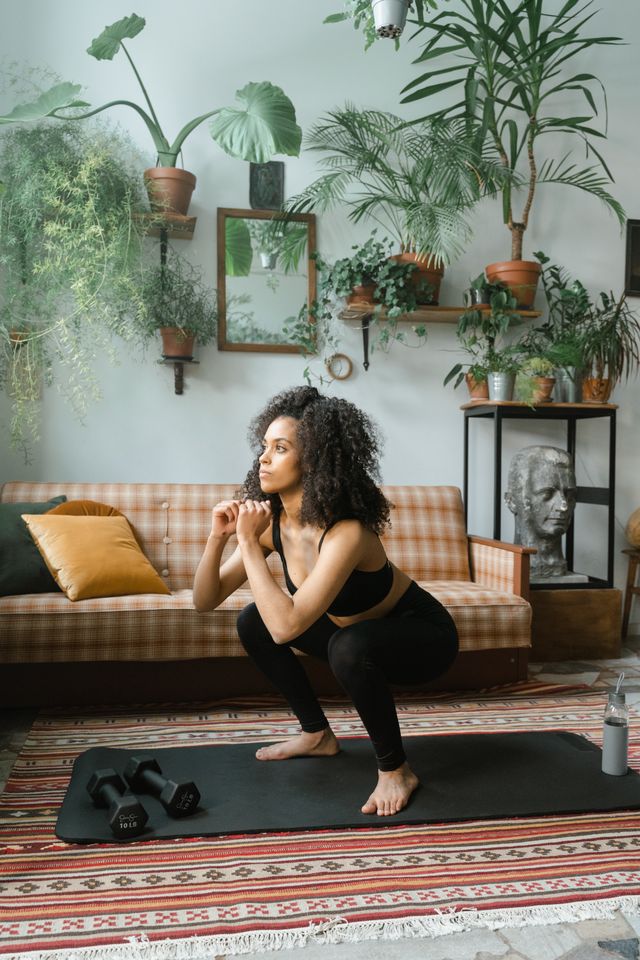
Stand with feet shoulder-width apart, chest up, and sit your hips back and down as if lowering into a chair. Keep your knees tracking over your toes and your heels on the floor. Go as low as you comfortably can, then push through your heels to stand. Squats work the thighs, hips and glutes, and they are the single most useful lower-body move you can do at home. Aim for two or three sets of 10 to 15 repetitions.
Lunges
Step forward into a long stride, lower your back knee towards the floor, then push back to standing. Keep your front knee over your ankle rather than letting it drift past your toes. Lunges work each leg separately, which helps balance and catches strength differences between sides. Hold the back of a chair if balance is tricky. Aim for two or three sets of eight repetitions per leg.
Push-Ups
Start in a plank position with hands under your shoulders, lower your chest towards the floor, then push back up. If a full push-up is too hard, do them from your knees, or with your hands on a kitchen counter or the arm of the sofa. The raised version is still a genuine push-up and a good place to start. Push-ups work the chest, shoulders and triceps. Aim for two or three sets of as many good repetitions as you can manage.
Plank
Rest on your forearms and toes with your body in a straight line from head to heels, hips level, breathing normally. The plank trains the deep core muscles that support your spine. Start with three holds of 20 seconds and build towards a minute.
Glute Bridge
Lie on your back with knees bent and feet flat. Push through your heels to lift your hips until your body forms a straight line from shoulders to knees, squeeze at the top, then lower slowly. This strengthens the glutes and hamstrings, which spend most of the day switched off when you sit. Aim for two or three sets of 12 to 15 repetitions.
better sleep helps your body recover from exercise
A 20-Minute No-Equipment Workout
Here is a complete session using the moves above, plus a warm-up and cool-down. No equipment, no jumping, and nothing that needs much space. Move at a steady pace and rest for 30 to 60 seconds between rounds.
Warm up (3 minutes): march on the spot for a minute, then ten arm circles in each direction, ten gentle leg swings per leg, and ten slow squats.
Main circuit (12 minutes): do three rounds of the following, resting 60 seconds between rounds.
- 12 squats
- 10 push-ups, from knees or a raised surface if needed
- 10 lunges per leg
- 12 glute bridges
- 30-second plank
Cool down (5 minutes): walk slowly for a minute, then stretch, holding each for 20 to 30 seconds: standing quadriceps stretch, hamstring stretch with your foot on a chair, chest stretch in a doorway, and a gentle seated spinal twist.
That is the whole session. If it feels too easy after a couple of weeks, add a fourth round, slow each repetition down, or hold a filled rucksack while you squat and lunge. If it feels too hard, cut the repetitions in half and build up. The right difficulty is the one that leaves you warm and a little breathless, not exhausted.
Common Mistakes To Avoid
Home workouts fail in predictable ways, and most of them are easy to fix once you know what to watch for.
- Skipping the warm-up: cold muscles are stiffer and more likely to complain. Three minutes of gentle movement makes the session feel easier and safer.
- Rushing the repetitions: fast, sloppy squats and push-ups work the wrong muscles and strain joints. Slow down, especially on the lowering part of each move.
- Holding your breath: breathe out on the effort, such as pushing up from a squat or a push-up, and breathe in as you lower. Holding your breath raises blood pressure and makes the move feel harder.
- Only training what you enjoy: it is tempting to skip leg day, but the legs hold the largest muscles in the body and drive the biggest health benefits. Keep the routine balanced.
- Doing too much too soon: sore muscles the next day are normal when you start, but pain in a joint is not. If something hurts, stop that move and try an easier version.
Staying Motivated At Home
The hardest part of exercising at home is not the exercise. It is starting, especially when the sofa is right there and nobody is watching. A few habits make it much easier.
First, pick a fixed time and treat it like an appointment. Many people find mornings work best, before the day fills up, but the right time is the one you will keep. Second, lay out your clothes and mat the night before, or keep them in the same spot, so there is no setup to put off. Third, track the habit rather than the result: tick off each session on a calendar, and aim not to break the chain.
Music or a podcast helps, and so does a simple rule: you only have to do the warm-up. Once you have started, finishing is usually easy. If you miss a day, do not try to make it up with a double session. Just do the next one. Consistency beats intensity: a modest routine done three times a week for months beats a heroic week followed by nothing.
mindfulness can help you stay consistent with healthy habits
Frequently Asked Questions
Can You Get Fit Exercising Only At Home?
Yes. For general health and fitness, bodyweight exercise at home can build strength, improve balance and raise your heart rate enough to meet the NHS guidelines. The limits appear only at advanced levels, where heavier weights become necessary. Most people never reach that point.
How Many Days A Week Should I Exercise At Home?
Three sessions a week is a good starting point, plus walking on other days. That covers the NHS recommendation of strengthening on at least two days a week and 150 minutes of moderate activity overall. Add a fourth session once three feels easy.
Do I Need Equipment To Exercise At Home?
No. Bodyweight exercises use your own weight as resistance, and they are enough to begin with. A mat and a sturdy chair are useful, and resistance bands are a cheap next step if you want more challenge. Weights are an option later, not a requirement at the start.
Is It Safe To Exercise At Home If I Am A Beginner?
For most healthy adults, yes, provided you start gently, warm up, and stop if something hurts. If you have a heart condition, high blood pressure, joint problems or another health condition, speak to your GP first. The British Heart Foundation’s home workout guide has sensible advice for starting safely.
Conclusion
Exercising at home works because it removes the obstacles that stop most people: travel, cost, embarrassment and time. You need a small patch of floor, twenty minutes and a handful of moves done well. Start with the 20-minute routine in this guide, three times a week, and walk on the other days. Within a month it will feel easier, and within a few months it will feel like something you simply do. That is the real goal: not a perfect workout, but a habit that stays.
Leave a Reply