
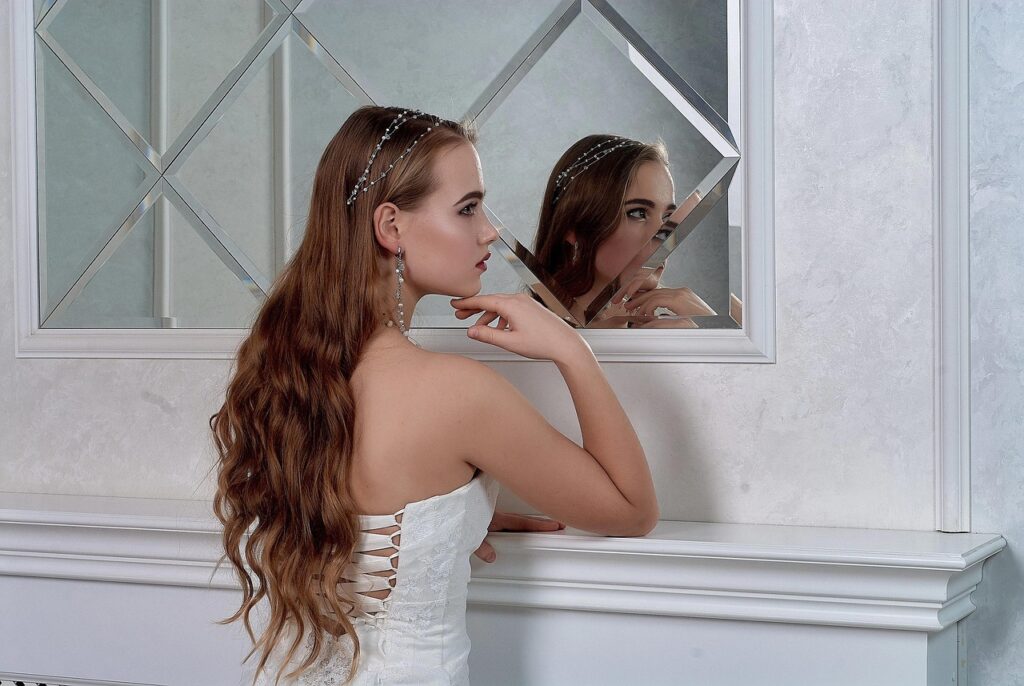
A lace wedding dress is a bridal gown in which lace is the main decorative fabric, used across the bodice, sleeves, skirt or the whole dress. It can look romantic, classic or modern depending on the type of lace, the silhouette underneath it and the way it is placed. A fine, sheer lace over tulle gives a soft, floating effect, while a bold, heavy lace on a clean-lined gown makes a strong visual statement. The lace you choose also affects how the dress moves, how warm it feels and how it photographs. Many brides begin with a picture in mind and then discover in a boutique that the same lace looks very different on a different shape. This guide explains the main lace types, the silhouettes they suit, and how to choose, fit and care for a lace gown.
What Is A Lace Wedding Dress?
A lace wedding dress is usually made by layering lace over another fabric, most often tulle, satin, crepe or a lining that matches the dress colour. The lace may cover the whole gown, or it may appear only in places: on the bodice, as sleeves, along the hem, as a train, or as appliqués, which are individual lace motifs cut out and sewn onto the dress. Ivory lace over an ivory lining looks classic and uniform, while ivory lace over a blush or nude lining makes the pattern stand out more clearly. Lace itself is an openwork fabric, made by looping, twisting or knotting threads into a pattern, rather than by weaving a solid cloth. Most lace on modern wedding dresses is machine-made. What matters is how it looks and feels on the body. Chantilly, Alençon and guipure are types of lace, defined by how they are constructed. Appliqué, by contrast, is a technique: it describes lace motifs being placed onto a gown, whatever type of lace they came from.
The Main Types Of Bridal Lace
Three names appear again and again in bridal shops: Chantilly, Alençon and guipure. They look and behave quite differently, and each suits a different kind of dress.
Chantilly Lace: Delicate, Light And Romantic
Chantilly lace is a fine, lightweight lace with delicate floral patterns on a sheer net ground. It originated in France, in the town of Chantilly, and developed in the seventeenth century, according to bridal lace guides. Its motifs sit relatively flat against the net, so the fabric drapes closely and adds very little weight or bulk. The effect is soft and romantic, especially when the lace is used for sheer sleeves, an illusion neckline or a flowing skirt. Chantilly is a good choice for a light, airy dress, for a garden, summer or destination wedding. Its delicacy is also its weakness: fine Chantilly can snag more easily than heavier laces, and it offers little structure on its own.
Alençon Lace: Classic, Defined And Structured
Alençon lace is a French needle lace associated with the town of Alençon, and it is often called the “Queen of Lace” in bridal writing. Its floral motifs are worked on a net ground with raised, corded outlines, a thicker thread that traces the edge of each motif and gives the pattern definition and a slightly three-dimensional quality. Compared with Chantilly, Alençon has more body and structure, and the pattern reads more clearly from a distance. That definition makes Alençon a natural fit for classic and formal weddings, structured bodices, ball gowns and A-line dresses. Historically, Alençon lace was handmade needle lace, which was exceptionally labour-intensive. Today, the name is also used for machine-made lace with corded floral motifs that resembles the traditional design, so a dress described as featuring Alençon lace does not necessarily contain handmade French needle lace.
Guipure Lace: Bold, Textural And Modern
Guipure lace, also known as Venetian lace, is the boldest of the three main bridal laces. Unlike Chantilly and Alençon, it has no fine net ground behind the pattern. Instead, large decorative motifs are joined to each other by small bars or bridges, leaving open spaces between them. The result is a heavier, more substantial fabric with a sculptural quality, and a pattern that is visible from across a room. Guipure suits brides who want a dress with a strong visual identity, and it works well on clean-lined gowns and modern designs. Because it has more body than Chantilly, it can hold a shape on its own, and it does not fray easily, which makes it easier to handle during alterations. The trade-off is weight and warmth, so it is usually best where the lace is allowed to be the main feature.
Other Laces And Terms You May Hear
Beyond the three main types, a few other terms appear regularly in bridal shops. Corded lace is lace in which parts of the pattern are outlined with a thicker cord, giving the motifs more relief; Alençon is the best-known example. Embroidered tulle is tulle with embroidery worked onto it, and many fabrics described simply as “lace” in contemporary collections are in fact embroidered tulle rather than a traditional lace construction. Lace appliqué, as noted above, is a placement technique rather than a lace type: individual motifs are cut from lace fabric and sewn onto the gown, often scattered across a tulle skirt or concentrated on the bodice and train.

Lace Wedding Dress Silhouettes And What Suits Them
An A-line dress is fitted through the bodice and flares gently from the waist, and it suits many body shapes and many venues. Almost every lace type works on it: Chantilly gives a soft, romantic A-line, Alençon gives it definition and a classic feel, and guipure gives it a modern, graphic character. A ball gown has a fitted bodice and a full, dramatic skirt, and it is the most formal of the common silhouettes. A sheath or column dress falls in a straight, narrow line from the shoulders to the hem, and Chantilly and embroidered tulle are natural choices here, as their lightness suits the clean line. A mermaid or trumpet dress is fitted through the bodice, waist and hips, then flares out at or below the knee, and Alençon and guipure both suit it, as their defined patterns follow the curves of the dress. Try sitting down in a fitted dress before you decide, not only standing in front of a mirror.

Choosing Lace For The Season And Venue
Season and venue do not dictate your choice, but they do affect comfort. For spring and summer, lighter laces such as Chantilly and embroidered tulle are natural choices, especially in flowing silhouettes with short or sheer sleeves. A lighter lining will breathe better, and a shorter train will be easier to manage on grass or gravel. For autumn and winter, Alençon and guipure offer more substance and warmth, and long lace sleeves can be both practical and elegant. A long train can catch on stone floors or grass, so ask about a bustle, a way of lifting the train for the reception.
How To Choose Your Lace Wedding Dress
Treat the first fittings as research, not as a decision. Try a range of lace types and silhouettes, even ones you think you will not like, because lace behaves differently on the body than it does in a photograph. Check the lace up close and from a distance. Up close, look at whether the pattern is clear, whether the edges are finished neatly, and whether the lace feels smooth or scratchy. Move in it: walk, sit, raise your arms and turn around. Alterations are part of choosing a lace dress, not an afterthought. Lace is harder to alter than plain fabric, because the pattern must be matched across seams and the edges re-finished. Ask early what alterations are possible, how long they will take, and what they will cost.

Accessories, Veils And Styling A Lace Dress
A lace wedding dress already carries a lot of visual detail, so accessories usually work best when they complement the lace rather than competing with it. A plain tulle veil lets the dress lace stand out, while a lace-edged veil can echo its pattern. If you choose a lace-edged veil, check that its lace does not clash with the lace of the dress, because two different lace patterns placed side by side can look busy. Jewellery should be chosen with the neckline in mind. A high lace neckline often needs no necklace, and earrings or a bracelet may be enough. A lower neckline can take a simple pendant or a delicate chain, but a heavy necklace can fight with the lace pattern. For more ideas on dressing for a special occasion, see our guide to what to wear to a spa day, our guide to the Ike jacket, and our guide to long white wigs for bridal hair and styling inspiration.
Caring For A Lace Wedding Dress
Before the day, store the dress in a breathable garment bag, away from direct sunlight and damp, and avoid a wire hanger that could snag the lace. If the dress needs steaming, ask a professional bridal cleaner or the boutique to do it. After the wedding, do not leave the dress uncleaned for months: stains can set, and lace can yellow if stored dirty. Take the dress to a cleaner who has experience with bridal gowns and lace, and tell them what the dress is made of and where the stains are. Ask about preservation if you want to keep the dress long term: professional preservation usually involves cleaning, acid-free tissue and a storage box.
Common Mistakes To Avoid With Lace Wedding Dresses
- Choosing lace from a photograph alone, without feeling the fabric and seeing how the pattern reads on your body.
- Assuming all lace described as Alençon or Chantilly is handmade French lace, without asking how the fabric was made.
- Ignoring the lining, which controls the colour, comfort and support of the dress.
- Ordering a dress without checking alteration limits, timelines and costs for lace.
- Pairing two different lace patterns, on the dress and the veil, that clash rather than complement each other.
- Leaving cleaning and preservation until months after the wedding, when stains may have set.
A lace wedding dress works best when the lace, the silhouette, the venue and the season are considered together. Chantilly offers lightness and romance, Alençon offers classic definition, and guipure offers a bold, modern statement. The best dress is the one that fits well, feels comfortable for a full day, and suits the place where you will wear it.
Frequently Asked Questions About Lace Wedding Dresses
What Is The Most Popular Lace For Wedding Dresses?
Chantilly, Alençon and guipure are among the most widely used laces for wedding dresses. Chantilly is known for its delicacy, Alençon for its defined, corded pattern, and guipure for its bold, substantial motifs. The best choice depends on the silhouette, the formality of the wedding and the look you want.
How Do I Tell Chantilly Lace From Alençon Lace?
Chantilly lace has fine, flat floral patterns on a sheer net and feels light and soft. Alençon lace has floral motifs with raised, corded outlines that give the pattern more definition and a slightly three-dimensional feel, and its pattern is easier to see from a distance.
Can A Lace Wedding Dress Be Altered?
Yes, in most cases, but lace is harder to alter than plain fabric because the pattern must be matched and the edges re-finished. Common alterations include taking in the bodice, shortening the hem and adjusting sleeves. Ask your boutique or seamstress early about what is possible, how long it will take and what it will cost.
Leave a Reply