
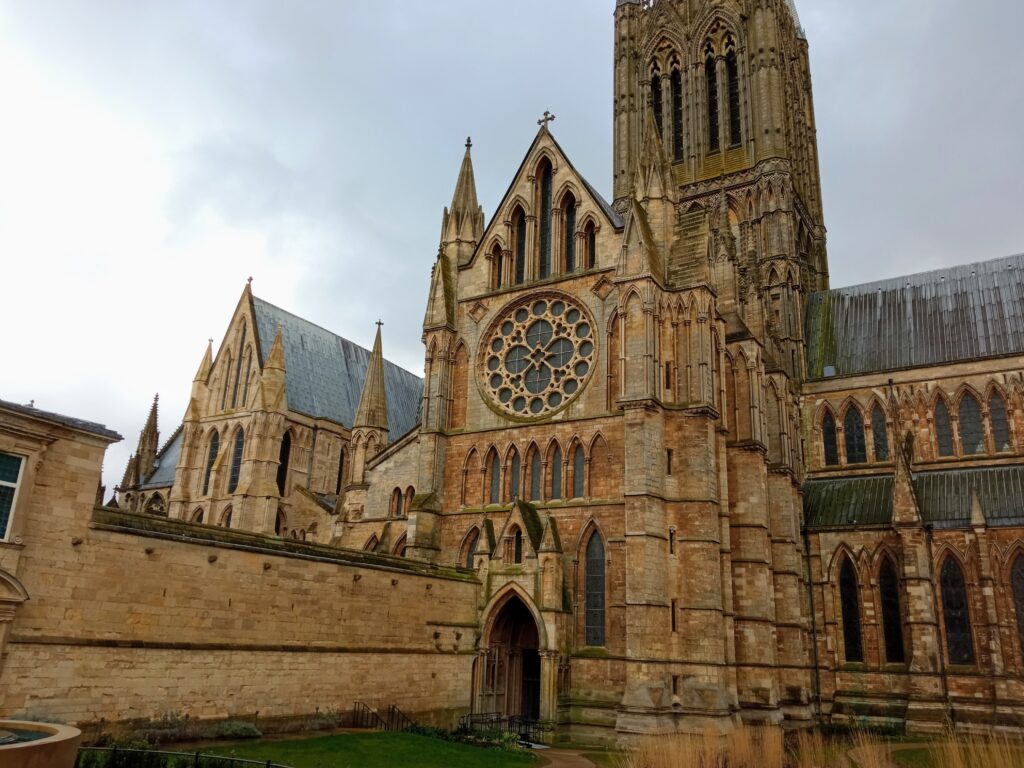
Lincoln is one of England’s most rewarding historic cities, and one of its most overlooked. It is a cathedral city and the county town of Lincolnshire in the East Midlands, split between two levels: the historic uphill quarter around the cathedral and castle, and the busier downhill city with its shops, university, and waterfront. The climb between them is steep, but it is also one of the most charming walks in England. Lincoln packs a Gothic cathedral that was once the tallest building in the world, a Norman castle holding an original Magna Carta, one of the steepest streets in the country, and a Roman harbour turned waterfront into a compact, walkable centre. One full day covers the main sights comfortably, while two days let you slow down and enjoy the museums, gardens, and riverside properly.
Visit Lincoln Cathedral
Lincoln Cathedral is the city’s main attraction and one of the finest Gothic buildings in Europe. Work began in 1072, and after an earthquake damaged the building in 1185 it was rebuilt in the new Gothic style. Its central spire once made it the tallest building in the world, until the spire fell in a storm in the 16th century. The cathedral remains an extraordinary sight inside and out, with soaring stone arches, two great round windows known as the Dean’s Eye and the Bishop’s Eye, a many-sided chapter house, and a library designed by Sir Christopher Wren. Look for the carved Lincoln Imp in the Angel Choir, a small stone figure that has become the city’s unofficial mascot. General admission includes a free guided floor tour, and themed roof and tower tours run on most days for an extra charge. The tower climb involves 338 steps and needs a reasonable level of fitness. Evensong is free and open to all, and it is a lovely way to hear the building at its best. Allow at least an hour, and check current admission details and opening times before you go, as services and events can affect access.
See Magna Carta At Lincoln Castle
A short walk from the cathedral, Lincoln Castle was built by William the Conqueror in 1068, on the site of the old Roman fortress. Its walls enclose a large green, and you can walk right around the top of them on the Medieval Wall Walk, with views over the cathedral, the city, and the countryside. The castle grounds are free to enter. The castle holds one of only four surviving copies of the original Magna Carta of 1215, the charter that limited the power of the king and became a symbol of liberty around the world. It is shown in the Magna Carta Vault beside the 1217 Charter of the Forest. A day ticket also covers the Victorian Prison, a stark reminder of the castle’s later life as a prison and courthouse, and the wall walk. Part of the wall walk is currently closed for essential repairs, so check the castle website before planning your visit around it. Allow at least half a day if you want to see the vault, the prison, and the walls without rushing.
Walk Up Steep Hill And Explore The Bailgate
Steep Hill is exactly what its name promises: a cobbled street that climbs steeply from the lower city up to the cathedral and castle. With a gradient of around 1 in 7, it is one of the steepest streets in England, and the climb is hard work, especially near the top, where handrails help. The reward is a street lined with independent shops, tea rooms, bookshops, and galleries, which makes the climb feel like part of the visit rather than a chore. Halfway down are the Norman House and, at the foot, the Jew’s House, both 12th-century town houses still in use. The best advice is to walk down Steep Hill, not up: take a taxi or bus to the top and save your legs for the cathedral and castle. At the top sits the Bailgate, the historic quarter between the castle and the cathedral. Its streets are lined with Georgian houses, small museums, and places to eat, and the whole area is mercifully flat once you are up there.
Cross High Bridge To Brayford Waterfront
Down in the lower city, the River Witham runs through the centre, and the walk along it is one of the most relaxing things to do in Lincoln. High Bridge, built about 1160, is the oldest bridge in Britain still carrying buildings, with a timber-framed Tudor row over the river. Follow the river west through the Glory Hole to Brayford Pool, an old Roman harbour that is now a lively waterfront of restaurants, bars, and the university. Brayford Pool is described as England’s oldest inland harbour, and it links the River Witham with the Foss Dyke, a canal built by the Romans around 120 CE, when the city was known as Lindum Colonia. Boat trips run from the waterfront in summer, and the area is lively in the evenings. From here, the High Street and the main shopping area are a short walk away, and Lincoln Central station is close by.
Pay Your Respects At The International Bomber Command Centre
On Canwick Hill, overlooking the city, stands the International Bomber Command Centre, a memorial and museum that tells the story of RAF Bomber Command. It opened in 2018 and serves as Britain’s memorial to the 57,861 aircrew from Bomber Command who lost their lives during the Second World War, their names recorded on the memorial walls. A tall memorial spire stands at the centre of the site, deliberately positioned so that Lincoln Cathedral is visible from it, and landscaped Peace Gardens surround the memorial. Inside, the exhibition centre tells personal stories through testimonies, film, and artefacts, including material from the bombing campaigns on both sides of the conflict. It is a moving, thoughtfully presented visit, and it deserves at least an hour. The centre is a short drive or bus ride from the city centre, and opening days and times vary by season, so check before you go.
Museums And Roman Lincoln
Lincoln’s history goes back far beyond the Normans. The Romans established a fortress here, and traces of that past survive around the city, including the line of the old Roman walls and the Foss Dyke canal. The city’s main museum, The Collection, has been closed since October 2024 for redevelopment and is expected to reopen in 2027, so check its status before building a museum-heavy day around it. In the meantime, the cathedral, castle, and Bomber Command Centre cover the city’s history well, and the Bailgate area rewards a slow wander, with its historic houses and small galleries. If you enjoy Roman history, look for the city’s Roman remains as you walk between the uphill and downhill areas, and remember that the steep climb you are making follows a route people have walked for nearly 2,000 years.
Practical Tips For Visiting Lincoln
Lincoln is a compact city, and most of the sights in this guide are within a short walk of each other, apart from the climb between the two levels. Wear comfortable shoes with good grip, because Steep Hill is cobbled and steep, and the cathedral quarter is best explored on foot. If the climb is too much, a taxi or bus can drop you at the top, by the cathedral, and both the cathedral and the castle have step-free routes and accessible toilets. Lincoln Central station is in the lower city, close to the shops and Brayford Pool, with direct trains to London King’s Cross in around two hours, and services to Nottingham, Sheffield, and Newark. If you are driving, use the park and ride sites or the car parks in the lower city rather than trying to park uphill. Lincoln is at its busiest in summer and during festival season, so book accommodation early for weekends. Many of the best things in the city are free, including the castle grounds, the Brayford waterfront, and the walk up Steep Hill, while the cathedral, castle attractions, and the Bomber Command Centre charge admission. Check opening times and ticket details before you travel, since seasonal hours and repairs can change what is open.
A Simple One Day Itinerary In Lincoln
If you have just one day, start at the top. Take a taxi or bus up to the cathedral when it opens, and spend the morning there, including the floor tour and a look for the Lincoln Imp. Cross to Lincoln Castle next for Magna Carta, the Victorian Prison, and the Medieval Wall Walk, then have lunch in the Bailgate. Spend the early afternoon wandering the Bailgate’s streets and shops, then walk down Steep Hill slowly, stopping at the tea rooms and independent shops on the way. Cross High Bridge and follow the river to Brayford Pool for a late afternoon drink by the water. If you have a second day, add the International Bomber Command Centre in the morning, then spend the afternoon exploring the lower city, the riverside walks, and the shops at a slower pace. This shape of day works because it puts the climb behind you early and leaves the gentler walking for the afternoon.
Conclusion
Lincoln rewards visitors who take their time. The cathedral and the castle are the landmarks that draw people in, but the lasting memories are often smaller: the view back down Steep Hill, the quiet of the cathedral at Evensong, the names on the memorial walls, or a coffee by Brayford Pool as the light changes. It is a city that mixes nearly 2,000 years of history into a walkable centre, from Roman harbour to Norman castle to a modern memorial, and it does so without the crowds of better-known historic cities. Plan around the big sights, leave room for the small ones, and check the practical details before you go. For another riverside city break, see our guide to things to do in Brighton.
FAQs
How Many Days Do You Need In Lincoln?
One full day is enough for the cathedral, the castle and Magna Carta, Steep Hill, and the walk down to High Bridge and the Brayford waterfront. Two days let you add the International Bomber Command Centre and explore the lower city and riverside at a slower pace without rushing.
Is Lincoln Cathedral Free To Visit?
No, there is an admission charge to visit Lincoln Cathedral outside services, and the charge includes a free guided floor tour. Themed roof and tower tours cost extra. Evensong is free and open to all. Check current admission details on the cathedral’s website before you visit.
What Is The Lincoln Imp?
The Lincoln Imp is a small carved stone figure in the Angel Choir of Lincoln Cathedral. According to local legend, the imp was turned to stone for misbehaving in the cathedral. It has become the city’s unofficial mascot and appears on souvenirs and local branding throughout Lincoln.
Is Steep Hill Very Steep?
Yes, Steep Hill is genuinely steep, with a gradient of around 1 in 7, and it is cobbled, so it needs care in wet weather. Most visitors find it easier to walk down rather than up. A taxi or bus can drop you at the top, by the cathedral, and the Bailgate area is flat once you are up there.
Can You See Magna Carta In Lincoln?
Yes, Lincoln Castle holds one of only four surviving copies of the original Magna Carta of 1215. It is displayed in the Magna Carta Vault, beside the 1217 Charter of the Forest. A day ticket to the castle covers the vault, the Victorian Prison, and the Medieval Wall Walk.
Leave a Reply