
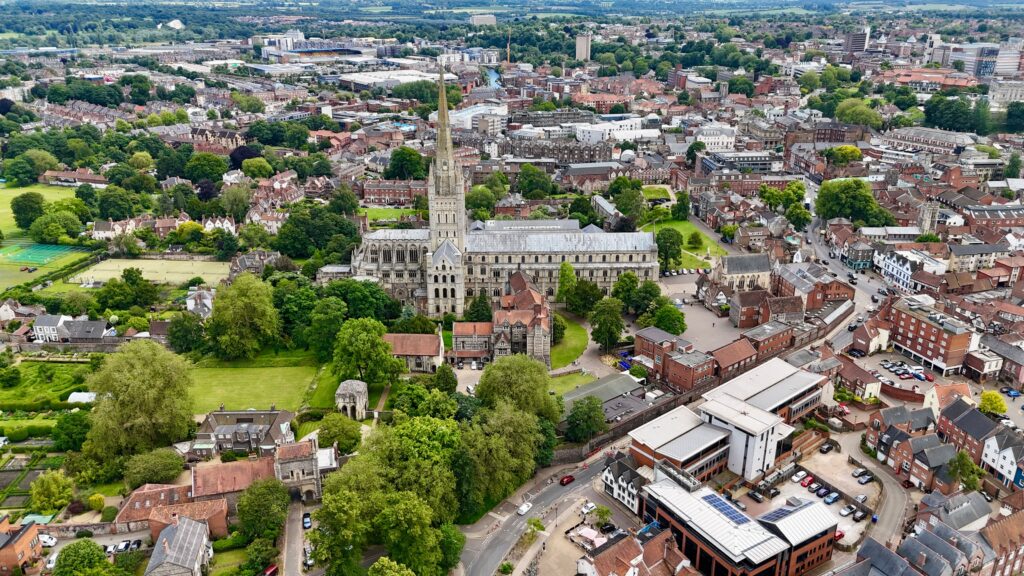
Norwich is one of England’s best-kept secrets, a compact medieval city in Norfolk that rewards visitors who take their time. It has a Norman cathedral and a Norman castle within a short walk of each other, a market that has traded for more than nine hundred years, and a maze of lanes filled with independent shops and cafes. Norwich was once England’s second city, and its wealth from the medieval wool trade is still visible in its flint churches, timber-framed houses, and grand civic buildings. Today it is England’s first UNESCO City of Literature, and it sits on the edge of the Norfolk Broads, a network of rivers and shallow lakes that gives the city a green, watery hinterland.
Visit Norwich Cathedral And Its Cloisters
Norwich Cathedral is the natural starting point for any visit, and it is one of the finest Romanesque buildings in England. Work began in 1096, and the cathedral was completed in 1145, built from stone brought by boat from Normandy. It is the most complete Norman cathedral in England, with a long nave, a tall spire, and the largest monastic cloisters in the country. The cloisters are a peaceful square of arched walkways around a green, and they are a good place to pause after the grandeur of the nave. The Cathedral Close around the building is one of the largest and best-preserved cathedral precincts in Britain. Entry to the cathedral is free, with donations welcome, and guided tours usually run on weekdays. Allow at least an hour. Check current opening times before you visit, as services and events can affect access.
Explore Norwich Castle Museum And Art Gallery
Norwich Castle stands on a great mound in the centre of the city, and its huge stone keep is impossible to miss. Founded by William the Conqueror in the years after 1066, the castle was rebuilt in stone in the twelfth century as a royal palace, and for centuries afterwards it was used as a prison. Today the keep holds a museum and art gallery, with collections covering archaeology, natural history, and art, and a recent major redevelopment has restored the scale and atmosphere of the medieval interior. The museum suits both adults and children, with galleries that explain the castle’s long history and the wider story of Norfolk. The castle mound itself is free to walk around, and the views from the top give a good sense of the city’s layout. Allow two hours if you want to see the galleries properly.
Walk Elm Hill And Tombland
Elm Hill is the prettiest and most famous street in Norwich, and it is often described as the most complete medieval street in England. The cobbled lane winds down from the church of St Peter Hungate towards the river, lined with timber-framed houses, most of them built after a great fire in 1507. Today the buildings hold independent shops, galleries, and cafes, and the street is at its best in the early morning or late afternoon. Look out for the fossilised keyboard set into the pavement at the corner of Princes Street and Elm Hill. From Elm Hill, wander through Tombland, the historic area between the market and the cathedral, where you will find the Crooked House, a leaning half-timbered medieval building. The streets around here are the heart of old Norwich, and they are best explored slowly, without a fixed route.
Browse Norwich Market And The Lanes
Norwich Market, in the heart of the city centre, has been trading for more than nine hundred years, and it is one of the largest and oldest open-air markets in England. The colourful striped stalls sell everything from fresh food and flowers to clothes, books, and street food, and it is a good place to pick up lunch or a souvenir. The market sits between the castle and the Guildhall, and it is busy on every day it trades. Around the market, the Norwich Lanes are a network of narrow streets filled with independent shops, vintage stores, and coffee houses. The Royal Arcade, an Edwardian shopping arcade with a tiled interior, is worth a look even if you are not buying anything. Together, the market and the Lanes are the best place in the city to shop for something unusual.
Discover The City’s Museums And Houses
Norwich has a fine set of smaller museums that bring its domestic and working history to life. Strangers’ Hall, a fourteenth-century merchant’s house in the city centre, is a museum of domestic life, with rooms decorated as they would have looked in Tudor, Georgian, and Victorian times. The Museum of Norwich at the Bridewell, in a former prison building, tells the story of the city’s trades and industries across ten galleries, from weaving to chocolate making. Out on the University of East Anglia campus, the Sainsbury Centre for Visual Arts is known both for its striking modern architecture and for its collection of art from around the world. It is a short bus ride from the centre and makes a good half-day trip, especially on a wet day. The Museum of Norwich and Strangers’ Hall have more limited opening patterns than the castle, so check their schedules before building a museum-heavy day.
Follow The River Wensum And Visit The Broads
The River Wensum runs through Norwich, and the riverside walk is one of the most relaxing things to do in the city. The walk passes Pull’s Ferry, a fifteenth-century flint building that was once a watergate, and Cow Tower, a medieval tower by the river that once guarded the city. From the riverside, you can see the cathedral from a different angle, and the paths are flat and easy. Beyond the city, the Norfolk Broads begin just to the east, a network of rivers and shallow lakes that has the status of a national park. Norwich is the gateway to the Broads, and a boat trip from the city or from nearby Wroxham is one of the best day trips in the county. Boats can be hired by the day, or you can join a short cruise, and the slow pace of the waterways is a complete contrast to the city centre. In summer, the Broads are busy with holiday boats, so book ahead if you want to hire one.
Find The City’s Quiet Corners And Gardens
Norwich has several quiet green spaces that visitors often miss. The Plantation Garden, a three-acre Victorian garden in a former chalk quarry near the city centre, has Gothic fountains, terraced walks, and a walled garden, and it is a peaceful place for an hour away from the shops. The Cathedral Close itself is green and calm, with lawns and trees that make it feel more like a village than a city centre. Earlham Park, to the west of the city, is a larger park with riverside walks and open lawns, while the Forum, the modern building beside the market, has a library, cafes, and a programme of free events. Norwich is also known for its many surviving medieval churches, more than thirty of them in the city centre, and several now hold exhibitions, concerts, and community events.
Practical Tips For Visiting Norwich
Norwich is a compact, walkable city, and most of the sights in this guide are within a short walk of each other. Trains run directly from London Liverpool Street, with the journey taking around two hours, and the station is a short walk from the city centre along the river. If you are driving, the city has several park and ride sites, which are usually easier than trying to park in the centre. Norwich is at its busiest in summer and during festival season, so book accommodation early, especially for weekends. Many of the best things in the city are free, including the cathedral, the market, Elm Hill, and the riverside walks, which makes it a good choice for a budget break. As with any historic city, check opening times before you travel, since museums and smaller attractions can have seasonal hours.
A Simple One Day Itinerary In Norwich
If you have just one day, start at Norwich Cathedral and the Close in the morning, when the light is good and the crowds are thin. Walk through Tombland and down Elm Hill, then cross to the market for lunch from one of the street food stalls. Spend the afternoon in Norwich Castle Museum, then browse the Lanes and the Royal Arcade before an early evening walk along the River Wensum. If you have a second day, add the Sainsbury Centre, the Museum of Norwich, and the Plantation Garden, or take a boat trip out to the Broads. This shape of day keeps you in the historic centre, avoids backtracking, and leaves time for the unplanned stops that make Norwich enjoyable, whether that is a coffee in a medieval lane or a look inside one of the city’s old churches.
Norwich is a city that grows on you. The cathedral and the castle are the landmarks that draw people in, but the lasting memories are often smaller: a cobbled lane in the morning, a market stallholder’s recommendation, or a quiet hour in a Victorian garden. It is a city best enjoyed slowly, on foot, with time to look up at the timber-framed houses and to follow the river. Plan around the big sights, leave room for the small ones, and check the practical details before you go. If you enjoy historic cities with a strong independent character, Norwich is one of the most rewarding weekends in England. For more ideas for British city breaks, see our guides to things to do in York and things to do in Chester, or plan a university city break with our guide to things to do in Cambridge.
Frequently Asked Questions About Things To Do In Norwich
How Many Days Do You Need In Norwich?
One full day is enough for the cathedral, the castle, Elm Hill, the market, and the Lanes. Two days let you add the museums, the Sainsbury Centre, the Plantation Garden, and a boat trip on the Norfolk Broads without rushing.
Is Norwich Cathedral Free To Visit?
Yes, entry to Norwich Cathedral is free, with donations welcome. Guided tours are usually available on weekdays, and the cloisters and the Cathedral Close are free to walk around. Check current opening times before you visit, as services can affect access.
Is Norwich Good For A Weekend Break?
Yes, Norwich suits a weekend break well. The city centre is compact and walkable, the cathedral, castle, and market are all close together, and the Norfolk Broads and the north Norfolk coast are easy day trips from the city.
What Is Norwich Famous For?
Norwich is famous for its Norman cathedral and castle, its medieval streets such as Elm Hill, its historic market, and its independent shops. It is England’s first UNESCO City of Literature, and it is the gateway to the Norfolk Broads.
Can You Visit The Norfolk Broads From Norwich?
Yes, the Broads begin just east of Norwich, and boat trips run from the city and from nearby Wroxham. You can join a short cruise or hire a boat for the day. In summer, book ahead, as hire boats are popular.
Leave a Reply