
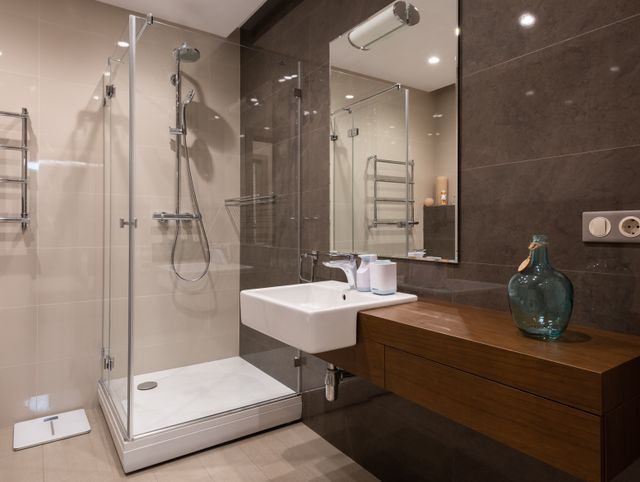
A bathroom wall does not have to stay bare. A framed print, a well-placed mirror, a row of patterned tiles or a small shelf can turn a plain room into a space that feels finished and calm. The problem is that a bathroom is not like any other room. Every hot shower fills the air with steam, water splashes near the sink and bath, and the temperature rises and falls again through the day. Wall decorations for a bathroom therefore need more thought than the same piece would need in a hallway. Choose the wrong material, or hang it in the wrong spot, and a print can ripple, a frame can swell and mould can grow where nobody looks.
Why Bathrooms Are Hard On Wall Decor
When you run a hot shower, warm damp air meets cooler surfaces and turns back into water. That condensation can settle on glass, on frames and on the face of a picture. Paper ripples when it absorbs moisture, canvas can sag, and wooden frames can warp as they swell and shrink with each cycle of heat and damp. Mould often starts on the back of a piece, where air cannot move and nobody thinks to look. A UK bathroom specialist, Renaissance Bathrooms, explains that the pieces which still look good years later are the ones somebody thought about before they went up, and that ventilation does most of the hard work in protecting them. Their guide to hanging art in a bathroom is a useful check before you buy anything. The rule is simple: pick decorations that either do not mind moisture or are properly sealed away from it, and hang them where splashes cannot reach.
Think of the bathroom in zones. The wet zone is the shower, where water lands directly. The steam zone is above the bath, where damp air gathers. The dry zone is the wall opposite the shower, the wall near the door and the space above the toilet, and most wall decorations belong there.
Start With The Driest Wall
Before you choose a single picture, stand in your bathroom and find its driest wall. In most rooms that is the wall opposite the shower, or the wall nearest the door. The wall above the toilet is another classic spot, because it is out of the splash range and gives you a natural focal point at eye level. Avoid the wall right next to the shower and anywhere above the bath where water tends to flick. If your bathroom has a window, also think about sunlight, because a bright window can fade prints faster than steam can damage them.
Ventilation matters as much as placement. A properly sized extractor fan, ideally one with a humidity sensor that keeps running for a while after you finish showering, does most of the hard work for you. Leave a small gap behind framed pieces, for example with small cork or felt bumpers on the bottom corners of the frame, so air can move behind the picture and mould is far less likely to take hold. Use stainless steel or brass hooks that will not rust, and only use adhesive strips if they are rated for damp rooms.
Framed Prints And Gallery Walls
Framed prints are the easiest way to bring wall decorations for a bathroom to life, and a small gallery wall can suit even a modest room. The trick is in how the frame is built. Prints behind glass or acrylic are a good place to start, but the key word is sealed. Ask your framer for a foam board backing rather than standard fibreboard, and for tape around the back edges so damp air cannot creep in behind the picture. Acrylic glazing is often the practical choice in a bathroom because it weighs less than glass and will not shatter, while glass offers excellent clarity and useful long-term protection from light. Plastic or resin frames are virtually unaffected by bathroom moisture, while wood frames need a fully sealed finish, painted, lacquered or waxed, on every visible and hidden surface.
For the image itself, choose prints made with pigment-based inks rather than dye-based inks, because pigment inks resist fading and bleeding in damp air far better. Sealed canvas prints cope better than paper too, especially with a protective varnish on the front and the edges, and images printed directly onto aluminium or acrylic shrug off steam and can be wiped clean. If you are building a gallery wall, keep it simple:
- Pick one clear focal point, such as a larger print above the toilet, and build smaller pieces around it.
- Keep the whole group on the driest wall, with even gaps between frames.
- Use two or three pieces in a small bathroom rather than six or seven.
- Hang everything level and at eye level, and check the group from the doorway before fixing the last hook.
Some things should never go on a bathroom wall, however good they would look against the tiles. Original oil paintings can develop a cloudy white haze known as blooming, along with cracking and mould, when they sit in damp air. Watercolours, pastels, gouache and charcoal are the most vulnerable of all. Old photographs, family heirlooms and anything else you could not replace should stay out too. A good reproduction will give you the same look without the risk, For broad inspiration on refreshing the whole room, see our 30 inspiring bathroom ideas.
Mirrors As Wall Decor
A mirror is the hardest-working wall decoration in any bathroom. It reflects light, makes a small room feel larger, and it is made for the job, because glass and a sealed frame do not mind steam at all. A round mirror above the sink softens a room full of straight lines, while a tall rectangular mirror can make a low ceiling feel higher. An arched mirror adds a gentle curve that suits both modern and traditional bathrooms, and a mirror with a slim metal frame in black, brass or chrome can pick up the colour of your taps and give the whole room a finished look.
Think of the mirror as part of the decoration, not just a tool for brushing your teeth. A pair of small matching mirrors above a double vanity looks smart and balanced, a large mirror on the wall opposite the window bounces daylight around the room, and a decorative mirror with an unusual frame can be the focal point of the wall, with no picture needed beside it. Keep the frame sealed and the fixings rust-proof, and a good mirror will outlast almost anything else you hang in the room.
Tiles, Panels And Paint As Decoration
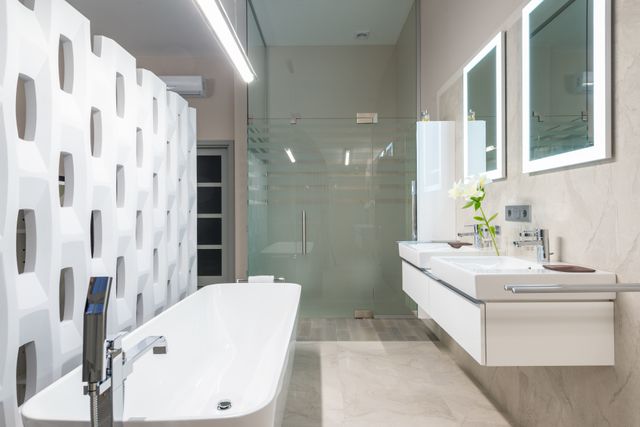
Sometimes the best wall decoration is the wall itself. A patterned feature wall behind the bath, a decorative panel of tiles, or a bold painted wall cannot be steamed off, and it needs no frame at all. Decorative tiles come in endless patterns, from classic encaustic-look designs to bold geometric shapes and soft handmade-look glazes. Use them on one wall only, and keep the other walls plain, so the pattern has room to breathe. A strip of patterned tiles at eye level, a tiled niche in the shower, or a full feature wall behind a freestanding bath all work well, and they are completely at home with water.
Small Bathroom Walls
Small bathrooms steam up faster than large ones, so decoration there needs to be simpler and tougher. One well-chosen piece usually looks better than several small ones, and a mirror is often the best single choice, because it adds light as well as decoration. Metal or acrylic prints, a decorative tile panel or a single framed print on the driest wall are all safe choices. Avoid filling every spare inch, because a small room with too much on the walls feels smaller, not more interesting. Use height to your advantage: a tall, narrow print or a vertical pair of small frames draws the eye upward and makes the ceiling feel higher. Light colours and simple frames keep the room feeling open, while a dark frame can work if it matches the taps or the vanity. Our bedroom decor ideas use the same rule of one focal point per wall, and it works just as well in a compact bathroom.
What To Avoid
A few common mistakes spoil otherwise lovely bathroom walls. The first is hanging unprotected paper art where steam can reach it, because paper ripples and mould follows, often on the back where you will not notice it until the damage is done. The second is using raw MDF frames, because the exposed back will swell and fall apart within weeks in a room that sees daily showers. The third is fixing heavy pieces with ordinary hooks or adhesive strips that are not rated for damp rooms, because a frame that falls can crack a basin or a tile. Keep these points in mind:
- Do not hang anything valuable, irreplaceable or made of unsealed paper beside the shower or above the bath.
- Do not use unsealed wood, gilded frames or raw MDF in a steamy bathroom.
- Do not block the extractor fan, and check the back of each frame every few months for damp or mould.
- Do not hang art in direct sunlight from a bathroom window, because light fades prints faster than steam damages them.
A Simple Plan For Your Bathroom Wall
If you are starting from a blank wall, keep the plan simple. First, find the driest wall and decide on one focal point, which might be a mirror, a framed print or a tile feature. Next, choose materials that suit the zone: sealed prints, metal or acrylic pieces, mirrors and tiles near steam, and paper or canvas only where the air stays dry. Then fix the piece properly, with rust-proof hooks, a small gap behind the frame for air, and the extractor fan doing its job. Live with it for a few weeks and check the back of the frame for any sign of damp. If it stays dry and looks good, you have found the right spot, and you can add a shelf or a plant to complete the wall.
Frequently Asked Questions
Can You Hang Canvas Art In A Bathroom?
Yes, as long as it is varnished on the front and the edges, the room is well ventilated and it is kept away from the shower. Canvas prints generally cope better than works on paper.
What Is The Best Wall Art For A Small Bathroom?
Small bathrooms steam up faster, so choose metal or acrylic prints, mirrors or a decorative tile panel. One well-chosen piece usually looks better than several small ones, and a mirror also makes the room feel larger.
Does Bathroom Wall Art Go Mouldy?
It can, particularly paper and the unsealed backs of frames in rooms with poor ventilation. A sealed frame, a small air gap behind it, and a good extractor fan make a big difference.
Where Is The Best Place To Hang Art In A Bathroom?
On the driest wall, usually opposite the shower, above the toilet or near the door, well away from splashes and direct sunlight.
Is Wallpaper Safe In A Bathroom?
Standard wallpaper is not a good choice, because steam will lift it and mould can grow behind it. Vinyl or specially made bathroom wallpaper can work on the driest wall, well away from the shower, if the room is well ventilated.
Sources
- Renaissance Bathrooms — Can You Hang Art In A Bathroom? (guidance on sealed frames, materials to avoid, placement and ventilation)
- FM Magazine — 30 Inspiring Bathroom Ideas
- FM Magazine — Picture Walls Living Room
- FM Magazine — Bedroom Decor Ideas
- Pexels — Modern Bathroom Design, photo by Max Vakhtbovych
- Pexels — Bathroom With Partition And Shower Cabin, photo by Max Vakhtbovych
Image credits (plain text): Featured image — Photo by Max Vakhtbovych on Pexels. Body image 1 — Photo by Max Vakhtbovych on Pexels.
Leave a Reply