
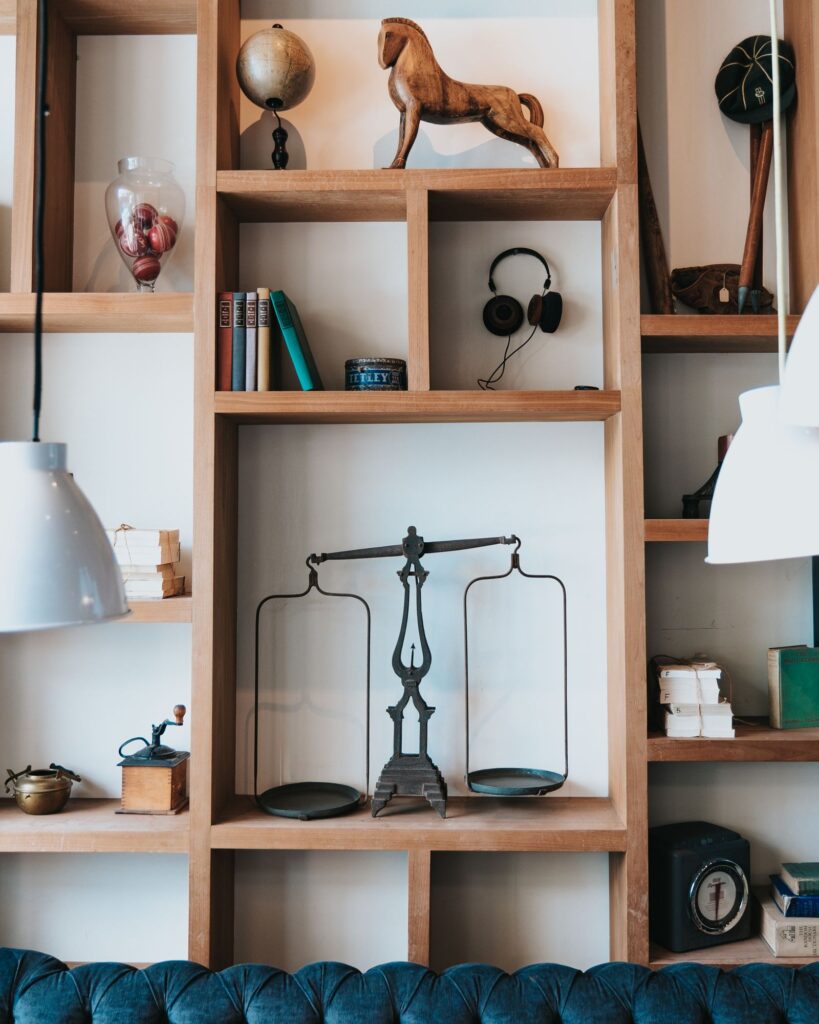
A styled bookshelf can be the best-looking feature in a room, but most bookcases end up as crowded rows of spines with a few ornaments squeezed in wherever they fit. The difference is not money or a large collection. It is a small set of rules that designers use every time: start with empty shelves, balance books with objects and empty space, vary the heights, and edit until each shelf can breathe.
Start With An Empty Shelf
Every good bookshelf starts empty. Take everything off the shelves and put it on the floor, then clean the shelves and look at the bare unit before you put anything back. This matters because a shelf styled on top of an existing arrangement is almost always a compromise: you keep things where they already are instead of placing them where they look best. Starting from empty lets you compose the shelf properly, like a designer working on a blank grid.
While the shelves are empty, sort what came off them into three piles. The first pile is books you want to display. The second pile is objects: vases, framed photos, ceramics, plants and anything sculptural. The third pile is everything that does not belong on a display shelf at all, such as chargers, remote controls and loose paperwork. Be honest with this pile, because the quickest way to a better-looking shelf is to remove the things that were never meant to be seen.
The Simple Formula: Books, Objects And Empty Space
A well-styled shelf balances three ingredients, and the one people forget is the third. Books are the bulk and the backbone, roughly two-thirds of what is on the shelf. They bring colour, mass and rhythm. Objects are the punctuation, about a third of the shelf: a ceramic vessel, a small plant, a framed photo or a sculptural bowl. They break up the wall of spines and make the display personal. Empty space is the deliberate gap between groups. A shelf packed from edge to edge has nowhere for the eye to rest, so even beautiful things blur into visual noise.
Think of each shelf in thirds: roughly one-third books, one-third objects and one-third air. This is a starting point rather than a strict law, and the exact balance can shift with the size of the shelf and the number of books you own. The principle underneath it stays the same: the empty third is what makes the filled two-thirds look like design instead of storage. If you cannot bear to leave a gap, put the empty space in the middle of a shelf, where it reads as a deliberate pause between two groups rather than a missing book.
How To Arrange The Books
The single move that makes shelves look considered is to stop standing every book upright. Use two orientations and alternate them. Vertical rows are the traditional upright line of spines. Keep them, but do not let them run wall to wall on every shelf, or the unit reads like a library return cart. Horizontal stacks are books laid flat in a short pile of two to four. They give the eye a calm rest between busy rows, and a stack of flat books becomes a pedestal for a small object on top.
A reliable pattern for one shelf is a vertical row held with a bookend, a horizontal stack topped with an object, and a gap between them. On the shelf below, reverse the order, so the heavy stack sits on the opposite side. This zigzag stops the bookcase from looking lopsided and keeps the eye moving down the unit instead of sliding off one side. When you arrange books by size, try the same trick: tall books on the left of one shelf and tall books on the right of the next, so the heights rise and fall in a wave down the bookcase.
Grouping books by colour is the fastest transformation in shelf styling. A rainbow arrangement can look striking, but it can also feel staged in an everyday room. A softer option is to group books into colour families: neutrals together, dark spines together and pastels together. Remove torn or ugly dust jackets first, because the cloth bindings underneath are usually prettier and more uniform. If you would rather find books by subject than by colour, group them by genre or author instead, and let the objects carry the colour.
How To Place Objects And Create Balance
Objects work best in small groups of odd numbers, usually one or three. A single hero object per shelf is often enough: one sculptural vase, one beautiful bowl or one framed print, with quieter books and a plain stack as its supporting cast. When you group three objects, vary their heights so their tops form a rough triangle, one tall, one medium and one low. This stops the arrangement from looking like a row of soldiers standing to attention.
Layer objects at different depths as well as different heights. Push some items to the back of the shelf and bring others forward, and lean a small framed print against the back of the shelf so it rises above the books in front of it. Round and curved shapes soften the straight lines of the books: a round vase or a curved sculpture contrasts nicely with rectangular spines. Metallic accents in brass or gold catch the light and add a little warmth, but use them sparingly, or the effect becomes busy.
How To Use Colour On A Bookshelf
Colour is what ties a bookshelf to the rest of the room. Start by looking at the colours already in the room: the sofa, the rug, the curtains and the wall colour. Then repeat two or three of those colours on the shelves, so the bookcase feels like part of the room rather than a separate display. If your living room is mostly neutral, a few deep green or navy book spines and one warm brass object will add depth without clashing.
One easy rule is to repeat each colour at least twice on the shelf. A green vase on the top shelf and a green book spine near the bottom create a thread that pulls the eye through the whole unit. Our guide to neutral living room ideas explains how warm neutrals, layered texture and a little contrast keep a room feeling calm, and the same thinking applies to a bookshelf: a mostly neutral shelf with one or two stronger colours looks planned, while a shelf with ten competing colours looks accidental.
How To Add Plants And Lighting
Plants are the easiest way to bring life to a bookshelf. A trailing pothos on a top shelf will soften the hard edges of the book spines as it grows down, and a small succulent on a horizontal stack adds green without taking up much room. Choose plants that suit the light where the shelf stands: a shelf beside a bright window can hold almost anything, while a dark hallway shelf needs a plant that tolerates low light, such as a snake plant or a pothos. Keep the pots small and simple, and use a saucer so watering does not mark the shelf.
Lighting makes a styled shelf look finished in the evening. A small battery-powered picture light above the bookcase, a slim LED strip under a shelf, or a table lamp on a nearby side table all work. Warm light suits wood and paper far better than cold white light, which can make a bookshelf look like a shop display. Dust the shelves regularly too, because open shelves collect dust quickly, and a dusty shelf undoes all the styling work in a week.
How To Style A Bookshelf In Different Rooms
The same rules apply everywhere, but the mix changes with the room. In a living room, the bookshelf is part of the seating area, so it should hold the books you actually read, a few personal objects and one or two plants. Keep the heaviest books low, where they are easy to reach, and leave the top shelf for display. Our guide to lounge room decor ideas covers the wider room, including focal points and furniture layout, which helps the bookshelf sit naturally in the space.
In a bedroom, a bookshelf should feel calm rather than busy. Use fewer objects, softer colours and books you return to at night. A small shelf beside the bed with a few favourite books, a small lamp and one framed photo is often more useful than a full bookcase. In a hallway, a narrow shelf works best with a small number of books and one statement object. In a child’s room, put the books they reach for at their height, keep heavy objects off the top shelves, and fix the bookcase to the wall so it cannot tip over.
Common Bookshelf Styling Mistakes To Avoid
- Filling every shelf edge to edge, so there is no empty space for the eye to rest.
- Standing every book upright, which makes the unit look like library storage.
- Using too many small objects, which read as clutter instead of decoration.
- Placing all the tall items on one side, which makes the bookcase look lopsided.
- Mixing too many colours with no repeat, so nothing ties the shelves together.
- Forgetting the back of the shelf: a painted or wallpapered back panel adds depth for very little effort.
- Never editing: take a photo of the finished shelf, look at it on your phone, and remove one thing from each shelf that the photo shows you do not need.
Conclusion
Styling a bookshelf is not about owning expensive objects or a perfect collection of books. It is about a method: empty the shelf, balance books with objects and empty space, alternate vertical rows with horizontal stacks, vary the heights, repeat two or three colours, and edit until each shelf can breathe. Do one shelf at a time and take a photo to check your work. Constico’s guide to styling a bookshelf walks through the same method step by step.
Frequently Asked Questions
How Many Books Should I Put On Each Shelf?
There is no fixed number, because it depends on the size of the shelf and the size of the books. A useful guide is the two-thirds rule: fill about two-thirds of each shelf with books and objects, and leave the last third as breathing space. If the shelf looks crowded, remove a few books rather than adding more objects.
Should Books Be Arranged By Colour Or By Subject?
Both work, and the right choice depends on how you use the books. Arrange by colour if the shelf is mainly decorative and you want the biggest visual change. Arrange by subject or author if you read from the shelf often and need to find books quickly.
How Do I Style A Small Bookshelf?
The same rules apply, but you need to be stricter about editing. Use one hero object per shelf, keep horizontal stacks to two or three books, and leave more empty space than you think you need. Small shelves look best with fewer, larger objects rather than many tiny ones, which disappear into clutter.
Can I Style A Bookshelf Without Buying Anything New?
Yes. The biggest improvement comes from editing what you already own: empty the shelf, remove what does not belong, regroup the books by colour or size, and use objects you already have, such as a vase from another room or a framed photo from a drawer.
How Do I Keep A Styled Bookshelf Tidy?
Give everything a home and keep the shelf to the two-thirds rule, so there is space to put a book back where it belongs. Dust the shelves once a week and do a quick edit once a month, removing anything that has crept onto the shelf and does not belong there.


Leave a Reply