
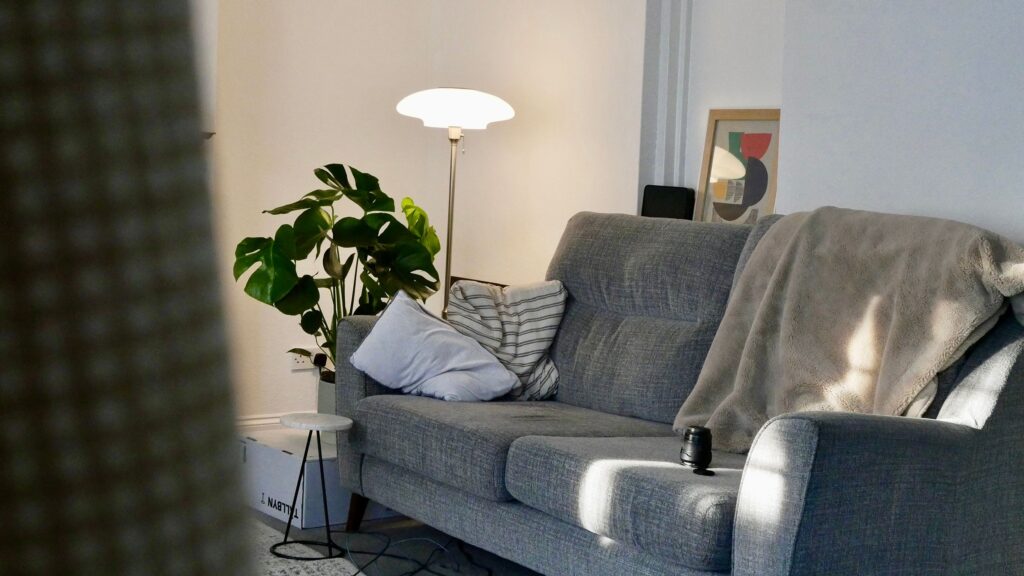
Choosing lamps for living room spaces is mostly about matching light to how you actually use the room. The right lamp makes reading easier, softens the room in the evening, and helps the space feel balanced rather than dark in the corners and harsh in the middle. The wrong lamp, by contrast, can glare, leave shadows where you sit, or simply look out of scale. This guide explains the main types of lamps for living room use, how to think about brightness and placement, and what to check before you buy, so you can choose with confidence and without needing technical knowledge.
Start with the room, not the lamp. Think about where you sit, where you read, where you watch television, and which corners feel dark after sunset. A living room usually needs more than one light source. One ceiling light alone rarely does the job well, because it lights the middle of the room and leaves seating areas in shadow. Lamps fill those gaps, and because they can be moved and switched on separately, they give you control over mood as well as brightness.
Start With How You Use The Room
Before you shop, spend an evening noticing your living room. Where do you sit most often? Do you read in an armchair, work on a laptop at the sofa, or mainly watch television? Do you need light for hobbies, homework, or conversation? Each use points to a different kind of lamp. Reading needs a focused light close to the chair. Television watching needs soft background light that does not reflect on the screen. Conversation needs gentle, even light so faces are easy to see without glare.
Types Of Lamps For Living Room Spaces
There are four main types to know, and most living rooms benefit from a mix of two or three of them. Floor lamps stand beside a sofa or chair and are useful where there is no side table. Table lamps sit on side tables, consoles, or shelves and are ideal for smaller spaces and for reading. Arc lamps curve over a sofa or chair and can act as a statement piece as well as a light source. Wall lamps and picture lights are fixed to the wall and save floor and table space, which is helpful in smaller rooms.
Each type has trade-offs. Floor lamps are easy to move but need floor space and a safe cable route. Table lamps are compact but need a stable surface at a useful height. Arc lamps make a strong visual impact but need room for their curve and base. Wall lamps save space but are harder to move once fitted, so they suit a layout you do not plan to change often. Choose the type that fits the space first, then look at style.
Floor Lamps For Corners And Reading Chairs
Floor lamps work well in corners, beside armchairs, and at the end of a sofa. A good reading floor lamp places its shade near shoulder height when you are seated, so light falls on the book or magazine rather than into your eyes. Look for a stable base, especially if the lamp will stand on carpet or near a walkway. A heavy base is less likely to tip if it is brushed by a pet, a child, or a vacuum cleaner. Check that the switch is easy to reach from your seat, so you do not have to get up in the dark to turn it off.
Table Lamps For Sofas And Side Tables
Table lamps suit side tables, console tables, and shelves. They are a good choice when you want light at a lower level than a floor lamp, or when a room already has a strong ceiling light and just needs softer side light. The shade should sit at a height where the bulb is hidden from your eye line when seated, which usually means the bottom of the shade is around eye level or slightly above it. A pair of matching table lamps on either side of a sofa or console can make a room feel balanced, while a single lamp can mark out a reading corner.
Brightness, Colour And Shade Choice
Brightness is often described in lumens rather than watts, especially as bulbs have changed. In simple terms, a higher lumen number means more light. For a living room, you usually want a mix: brighter light where you read or work, and softer light for relaxing. A dimmer switch, or a lamp with a dimmer control, is very useful because it lets you change the same lamp from task light to evening light without buying two lamps.
Colour temperature describes whether light looks warm or cool. Warm light, often described as warm white, tends to suit living rooms in the evening because it feels soft and cosy. Cooler light can feel clearer for reading or detailed work, but can also feel harsh if it is the only light in the room at night. If you are unsure, warm white is a safe starting point for a living room, and you can use a cooler bulb only in a dedicated reading lamp. Always check which bulb type and fitting the lamp takes before you buy, so you are not left with a lamp and no suitable bulb.
Shades shape light as much as bulbs do. A light-coloured fabric shade spreads light softly and glows gently. A dark shade directs light up and down and can look dramatic, but it gives less overall light to the room. A metal shade gives a more focused pool of light. Hold the shade at the height it will sit and think about glare: if you can see the bare bulb from your usual seat, the shade is probably too small, too high, or too open at the bottom.
Size, Scale And Placement
Scale matters more than style. A tiny lamp on a large side table looks lost, and a huge lamp on a small table looks top-heavy and is easier to knock over. As a general guide, the lamp and its shade should look in proportion to the furniture beside it. The lamp should not be much taller than the chair or sofa it sits beside, and its shade should not be wider than the table it stands on. These are general guides, not strict rules, but they help you avoid the most common mistake, which is choosing a lamp that is far too small for the space.
Placement follows the same idea. Place a reading lamp behind or beside the chair, slightly behind your shoulder, so light falls forward onto your reading material. Place lamps at the ends of a sofa to frame the seating area. Avoid placing a lamp directly behind a television, where it can create glare, and avoid placing a lamp where its cable crosses a walkway. If a socket is far away, use a cable cover or choose a different spot rather than running a loose cable across the floor, which is a trip hazard.
Layering Light In A Living Room
Layering simply means using more than one kind of light. A common approach is to combine a ceiling light for general brightness, lamps for task and accent light, and perhaps a small lamp or wall light for evening mood. You do not need to buy everything at once. Start with the lamp you need most, such as a reading lamp, then add a second lamp when you see which corner still feels dark. Switching lamps on separately gives you more control than relying on one bright ceiling light for every activity.
Choosing Lamps For Living Room Corners
Corners are often the hardest part of a living room to light. A floor lamp in a corner can soften a dark area and make the room feel larger, because light bounces off two walls. An arc lamp can also work in a corner, curving over a chair placed at an angle. If the corner holds a plant, a bookshelf, or a piece of art, a lamp nearby can highlight it without needing a separate spotlight. Keep the base clear of clutter so the lamp is stable and easy to switch on.
Practical Checks Before You Buy
Before you buy, check the practical details. Measure the space where the lamp will stand, including the height of the table or the distance from the chair. Check the socket location and cable length. Check whether the lamp needs assembly and whether you are comfortable with it. Check the bulb fitting, whether a bulb is included, and whether the lamp has a dimmer. If you buy online, check the return policy and the dimensions carefully, because photos can make a lamp look larger or smaller than it really is.
Also think about safety and care. Keep lamps away from curtains and other fabrics that could touch a hot bulb, and follow the maker’s guidance on bulb wattage. Dust shades regularly, because dust dims light and can dull a fabric shade over time. If a lamp wobbles, check that its parts are tightened and that it stands on a level surface before you use it regularly. These simple checks cost little time and help a lamp last longer.
- Measure the space, table height, and distance to the nearest socket.
- Check bulb fitting, brightness, and whether a bulb is included.
- Choose a shade that hides the bulb from your usual seat.
- Keep cables off walkways and away from trip hazards.
- Test the lamp in the evening, not just in daylight.
Lamps And The Rest Of The Room
Lamps should sit comfortably with the rest of the room. A lamp does not need to match everything else exactly, but its finish and shade should not clash with the main furniture. Wood, metal, and fabric finishes all work in living rooms, and a simple design often lasts longer than a very fashionable one. If you already have a scheme, look at guides for related rooms for ideas on how colours and textures work together. For example, Bedroom Accessories shows how small details can finish a room, and Cushion Covers explains how colour and fabric choices change the feel of seating areas, which is also relevant to choosing a lamp shade.
For a broader look at living-room ideas, Sofa Throw offers practical advice on soft furnishings that sit beside lamps in a seating area. For authoritative guidance on types of lighting for different rooms, IKEA UK Lighting describes floor, wall, table, and ceiling lighting and general, task, accent, and mood lighting in its lighting range, which is a useful reference when you compare lamp types. You can find it at IKEA UK Lighting.
Common Mistakes To Avoid
The most common mistakes are easy to avoid once you know them. Buying a lamp that is too small for the space is first. Placing a lamp where its bulb shines directly into your eyes is second. Using only one bright ceiling light for every activity is third. Forgetting to check bulb fitting and cable length is fourth. Buying a lamp for looks alone, without thinking about where you will sit and read, is fifth. If you avoid those five, most lamps will work well, even if they are not expensive.
Conclusion
Good lamps for living room spaces are not about spending the most or following a strict formula. They are about matching light to use, choosing a size that fits the furniture, and placing lamps where they help rather than glare. Start with how you use the room, add light in layers, check size, shade, bulb, and cable before you buy, and test the result in the evening. With those steps, a few well-chosen lamps can make a living room easier to read in, more comfortable to sit in, and more pleasant to spend time in after dark.
Featured image credit: Photo by Stephen / Pexels
Sources
- FM Magazine: Bedroom Accessories
- FM Magazine: Cushion Covers
- FM Magazine: Sofa Throw
- IKEA UK: Lighting
Leave a Reply