
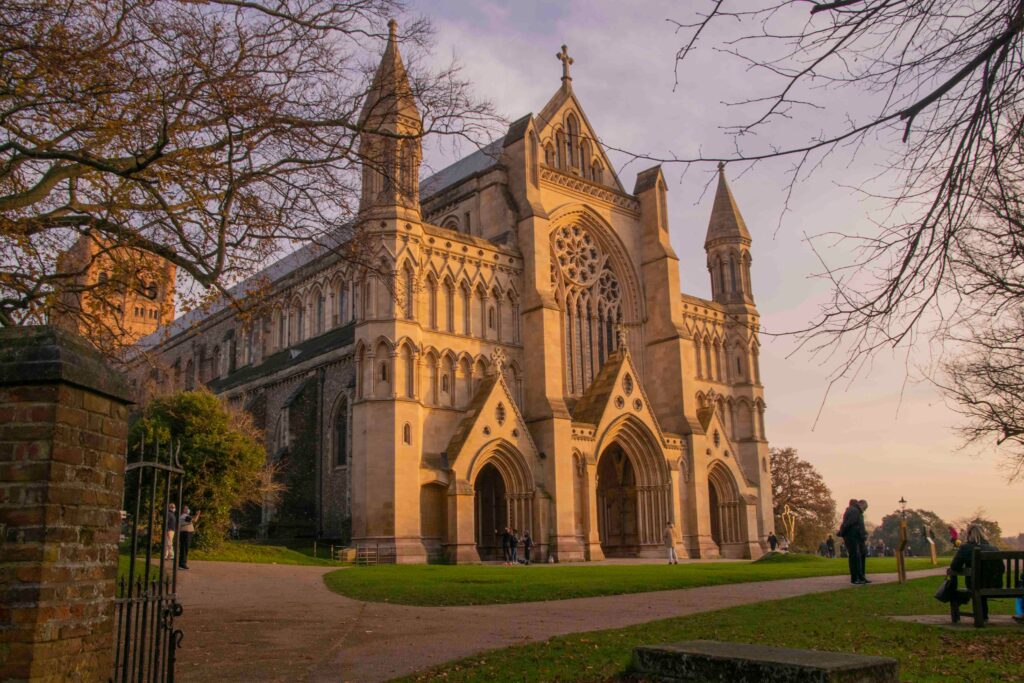
St Albans packs more than two thousand years of history into a city you can walk across in an afternoon. It began as Verulamium, one of the largest towns in Roman Britain, and grew into a medieval cathedral city around the shrine of St Alban, Britain’s first saint. Today it is one of the easiest day trips from London, roughly twenty minutes by train from the capital, and it rewards visitors with Roman walls and mosaics, a cathedral with the longest nave in England, a lively street market and acres of parkland. These are the best things to do in St Albans, whether you have a few hours or a full day.
Why Visit St Albans
St Albans works beautifully as a day trip because its history is layered rather than spread out. The Roman city, the medieval abbey and the Georgian market streets sit close together, so a short walk takes you through three eras. The city is compact, the centre is pleasant to explore on foot, and many of the best experiences cost little or nothing: the cathedral is free to enter, the Roman walls stand in a public park, and the market is free to browse. It suits history lovers, families and anyone who wants a gentler alternative to a busy London day out.
Visit St Albans Cathedral
St Albans Cathedral dominates the skyline from its position just north of the city centre, and it is the natural starting point for any visit. The present Norman church was built using bricks and tiles salvaged from the ruins of Roman Verulamium, a detail that ties the city’s two great periods together in a single building. The cathedral’s history stretches back to the shrine of St Alban, and the abbey that grew around it was founded by King Offa of Mercia in 793. Inside, the nave is the longest in England, measuring 85 metres, and the mix of Norman arches, medieval wall paintings and later additions gives the building a depth that rewards a slow look. Entry to the cathedral is free, with donations encouraged, and the building is generally open daily from 9am to 5pm, with entry through the Welcome Centre. Free guided tours run daily and last around an hour, and they are well worth joining if you want the stories behind the stones. For a different perspective, the tower tour climbs 211 steps up a steep medieval staircase and lasts about an hour. The view from the top is a fine reward, but the narrow stairs are not for everyone.
Explore Verulamium Park And The Roman Wall
Verulamium Park is where the Roman city comes back to life. The park covers 175 acres on the site of Verulamium itself, and it holds several of the city’s most important remains. The Roman wall still stands in places along the southern edge of the park, and the outline of the London Gate is visible in the grass. A lake, a splash park and wide lawns make this as much a place for a picnic as for history, and the park holds Green Flag and Green Heritage Site accreditation. Walking the park is free and it is easy to spend an hour here just following the wall and imagining the Roman city that once stood on the ground. The park also holds the Hypocaust and Roman mosaic, a preserved example of Roman underfloor heating with its mosaic floor, which is free to visit daily. It is a small site, but it brings Roman domestic life into sharp focus in a way that a museum case cannot.
Visit The Verulamium Museum
Beside the park, the Verulamium Museum stands on the site of one of the largest Roman cities in Britain and explores what everyday life was like in Roman Britain. Inside you will find mosaics, recreated Roman rooms, large-scale models and collections of Roman gold coins, along with artefacts recovered from the city itself. The museum is the one paid Roman attraction most visitors choose, and it gives the ruins outside a human context: the food, the trade, the homes and the people who lived here nearly two thousand years ago. Allow about an hour for a visit, and check opening times before you go, as the museum is generally open daily from 10am to 4pm.
See The Roman Theatre Of Verulamium
At the far edge of Verulamium Park stands the Roman Theatre of Verulamium, the only visible Roman theatre in Britain. Built into a hillside on the Gorhambury Estate, it once seated audiences for plays and public gatherings, and its curved banks are still easy to read today. The theatre opens only on Fridays and Saturdays, so plan around that if you want to go inside. It is also the cheapest paid attraction in the city, which makes it an easy addition to a day in the park. In summer, the theatre hosts open-air performances as part of a festival season running from June to August.
Climb The Clock Tower
The Clock Tower on the High Street is one of England’s oldest medieval town belfries and one of the most recognisable landmarks in St Albans. Built in the early fifteenth century, it has served as a watchtower, a curfew bell and a town landmark for centuries. Climbing it is a short, steep experience, but the view over the rooftops and towards the cathedral is one of the best in the city. The tower sits at the top of the market streets, so it is easy to combine with a browse of the shops below. Check whether it is open on the day of your visit, as access can vary.
Browse St Albans Charter Market
Time your visit for a Wednesday or a Saturday and you will catch the St Albans Charter Market, which has run in the city centre since it was established by Abbot Wulsin in 860. The market stretches from the Market Place up St Peter’s Street and fills the streets with stalls selling fresh produce, baked goods, artisan foods, crafts and clothing. There is a lively international street-food section, and a predominantly food and craft market also runs on the second Sunday of each month. A monthly farmers’ market brings local cheeses, seasonal fruit and vegetables, fresh bread and locally made crafts to the same streets. Even if you buy nothing, the market is the best place in the city to feel its everyday life.
Visit St Albans Museum And Gallery
Housed in the restored Georgian Town Hall on St Peter’s Street, the St Albans Museum and Gallery tells the story of the city through exhibitions, art and local history. The building itself is part of the attraction: built in 1831, it has a grand Assembly Room with ornate chandeliers, a courtroom and old cells you can walk through. Entry is free and the museum is open daily, which makes it an easy stop between the market and the cathedral. A cafe and shop sit inside, and the museum’s changing exhibitions mean there is usually something new even for returning visitors.
Step Into Ye Olde Fighting Cocks
Beside Verulamium Park stands Ye Olde Fighting Cocks, a timber-framed pub that claims to be one of the oldest in England, with a licence stretching back centuries. The building’s low beams and riverside setting beside the River Ver make it one of the most photographed pubs in the country, and it is a natural stop for lunch after the Roman sites. Whether or not the claim to be England’s oldest pub is one you accept, it is a genuinely atmospheric place to sit with a drink. The pub is close to the park lake, so it fits easily into a walk through Verulamium Park.
Enjoy The Parks And Green Spaces
St Albans is a greener city than many visitors expect. Beyond Verulamium Park, the River Ver winds through the city, and the paths along it make for gentle walks between the sights. Clarence Park, near the station, is a smaller formal park with tennis courts and a bandstand. For families, Willows Activity Farm at nearby London Colney offers a Peter Rabbit adventure playground, farm animals, tractor rides and shows, and it is one of the most popular family days out in the area. The de Havilland Aircraft Museum, also at London Colney, lets visitors get close to historic aircraft and is a good option for anyone with an interest in aviation history.
Getting To St Albans And Getting Around
St Albans is around 25 miles north of London, and trains from London St Pancras reach the city in about twenty minutes, which makes it one of the quickest historic day trips from the capital. The main station, St Albans City, is a short walk from the centre. Drivers can reach the city from the M25 and the A1(M), and there is public parking in the centre, though it fills up on market days. Once you arrive, everything is walkable. The cathedral, the park, the Roman sites and the market streets are all within a comfortable walk of each other, and the city centre is flat enough for most visitors.
Plan Your Day In St Albans
A good day starts at the cathedral in the morning, when it is quietest, followed by a walk down through Verulamium Park to the Roman wall, the hypocaust and the museum. Stop for lunch at Ye Olde Fighting Cocks or graze at the Charter Market if it is a Wednesday or Saturday. Spend the afternoon at the Clock Tower and the Museum and Gallery, then finish with a walk along the River Ver. If you are visiting with children, swap an hour of the afternoon for Willows Activity Farm. St Albans does not need a rigid plan; its pleasures are close together, and the best visits leave room to wander. For another historic day trip from London, see our guide to things to do in Norwich.
FAQs
Is St Albans Worth Visiting For A Day Trip?
Yes. St Albans is one of the best day trips from London, with Roman ruins, a cathedral with the longest nave in England, a historic market and large parks, all within a short walk of each other. Trains from London take around twenty minutes, so it is easy to fit into a single day.
What Is St Albans Famous For?
St Albans is famous for its Roman past as Verulamium, one of the largest towns in Roman Britain, and for St Albans Cathedral, built over the shrine of St Alban, Britain’s first saint. The Charter Market, running since 860, and the medieval Clock Tower are also well known.
Is St Albans Cathedral Free To Enter?
Yes, entry to St Albans Cathedral is free, with donations encouraged. The cathedral is generally open daily from 9am to 5pm. Guided tours are free, while the tower tour, which involves 211 steps, is a paid extra.
When Is St Albans Market On?
The Charter Market runs every Wednesday and Saturday from 9am to 4.30pm along St Peter’s Street and the Market Place. A food and craft market also runs on the second Sunday of each month, and a farmers’ market visits once a month.
How Long Does It Take To Get To St Albans From London?
Trains from London St Pancras to St Albans City take around twenty minutes. The station is a short walk from the city centre, which makes St Albans one of the fastest historic day trips from the capital.
Leave a Reply